Square acquires conversational AI startup Eloquent Labs

Square has acquired conversational artificial intelligence startup Eloquent Labs to help its merchants improve customer service.

Eloquent Labs, which raised a $1.5 million seed round back in early 2017, offers a conversational assistant named Elle to small businesses. The idea is that Elle will help merchants common customer service-related issues like returns, product tracking and FAQs.

“Eloquent’s conversational AI services are exactly the kind of technology that can level the playing field for businesses of all sizes by providing sellers efficient ways to interact with their customers,” Square wrote in a blog post. “The team will advance messaging across our entire ecosystem, and together we will build tools that leverage the latest in natural language processing research.”

There are a number of other startups in this space, including customer service software LiveChat, DigitalGenius and Olark. All three of those have raised more money than Eloquent Labs, which likely played a role in Square’s decision.

As concerns over medical device security rise, MedCrypt raises $5.3 million

As medical devices move to networked technologies, securing those devices becomes increasingly important.

Regulators, seemingly late to the threat that unsecured medical devices posed, only began requiring protections for medical devices like pacemakers and insulin pumps two years ago, and since then new technology companies have leapt into the breach to begin providing security services for the healthcare industry.

Most recently, MedCrypt, a graduate from the most recent batch of Y Combinator companies raised $5.3 million in a new round of funding, from investors led by Section 32, the investment firm founded by former Google Ventures partner Bill Maris.

Joining Maris’ firm were previous investors Eniac Ventures and Y Combinator itself.

“Internet-connected medical technology is entering the market at light speed, calling for devices to be secure by design, which leads to a heightened level of patient safety at all times,” said MedCrypt chief executive Mike Kijewski in a statement.

Securing patient data has been a longtime requirement for health technology companies, but both patient records and hospital networks are dangerously vulnerable to cyberattacks.

In 2018, over 6 million patient records in the U.S. were exposed thanks to network intrusions and cyberattacks, according to the publication Health IT Security. And those were just in the ten largest security breaches.

The healthcare industry has only managed to achieve 72% compliance with the HIPAA Security Rule for protecting patient data, according to an April report from CynergisTek.

Investors have recognized the problem and are investing more into companies focused on the healthcare market specifically. MedCrypt’s competition for these security dollars include companies like Medigate, which raised $15 million earlier this year.

While Medigate focuses on network security, MedCrypt is focused on securing devices themselves. Both security functions are critical, according to investors.

“With regulators appropriately taking a hard look at medical device security and the sheer growth in the number of devices being added to already complex clinical networks,” there is a significant opportunity for companies tackling medical device security, according to a statement from Dr. Jonathan Root who has led several IT-enabled healthcare investments for USVP.

Watch the Google I/O 2019 keynote right here

Google’s annual developer conference starts today, beginning as usual with a consumer-focused keynote where the company unveils new technology — devices, software, services and more for the first time. Today, we’re expecting to get news about Google’s new budget Pixel device, the Pixel 3a; its new mobile operating system Android Q; a new smart hub for the home, the Google Hub Max; and perhaps updates to other recently announced technology like game streaming service Stadia or the A.I. technology, Duplex. And plenty of other surprises, too, we hope!

The conference kicks off with the consumer keynote at 10 AM Pacific Time (1 PM on the East Coast and 6 PM in London). The developer keynote follows at 12:45 PM PST.

You can watch the live stream right here on this page, starting at 10 AM PST.

If you don’t have time to watch, don’t worry — TechCrunch will have all the news from I/O here: techcrunch.com/tag/google-i-o-2019

Shape Security’s latest product protects smaller businesses from credential stuffing

Shape Security has been helping big companies stay safe from fraudulent activities like password reuse and bot traffic on their publicly facing websites and apps. The company now wants to help smaller companies have that same type of protection, and today it announced a new cloud service called Connect aimed at that market.

“We’re an enterprise-focused company that protects the majority of large US banks, the majority of the largest airlines, similar kinds of profiles with major retailers, hotel chains, government agencies and so on. We specifically protect them against automated fraud and abuse on their consumer-facing applications — their websites and their mobile apps,” Shuman Ghosemajumder, CTO and co-founder at Shape Security explained.

The company has taken that same type of protection and packaged it for smaller businesses. “What we’re doing with the new product, which is called Connect, is automating those aspects which we have provided with the high-end [product], and are making it easier to deploy and run,” Ghosemajumder said.

He said that they get protection against the same kind of high-end, automated fraud that the large enterprise customers get, as well as protection against DDoS attacks, scraping and so on.

The company is best known for stopping the act of credential stuffing, a sophisticated kind of strike where attackers continually try to get onto a website or app using stolen usernames and passwords. In addition, they tend to use a variety of computers and IP addresses to mask the attack. In fact, Sumit Agarwal, who is co-founder and chief operating officer at Shape, coined the term when he was working at he was working at the Department of Defense in a previous position before he helped launch the company.

A product like Connect can help expand Shape’s market by moving beyond the large enterprises that have been its primary target up until now. While it provides a similar level of service, it delivers it in a way that makes it easier for these smaller organizations to consume, while still enabling them to take advantage of the advanced security techniques that would typically be out of their reach.

Shape Security was founded in 2011, but spent several years developing the core product before emerging from Stealth in 2014. It currently has 300 employees and has raised $132 million, according to Crunchbase data. The most recent round was $26 million in November.

Verified Expert Brand Designer: Kristine Arth

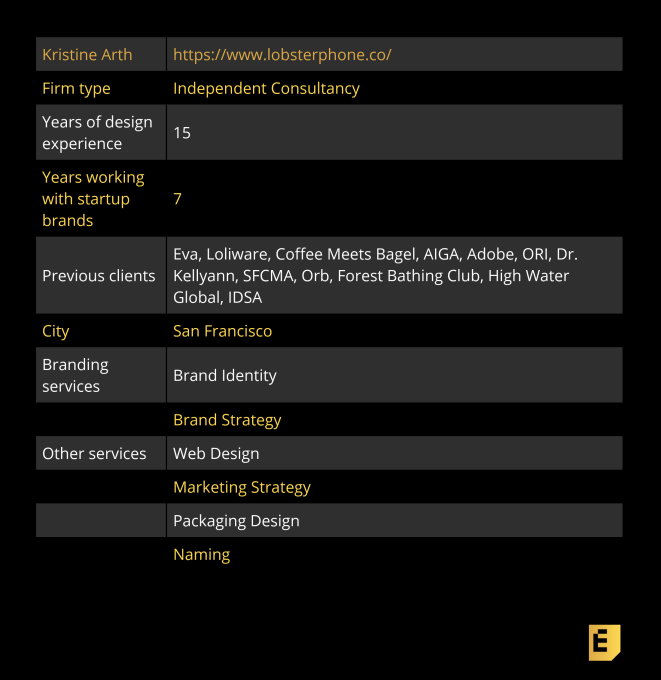
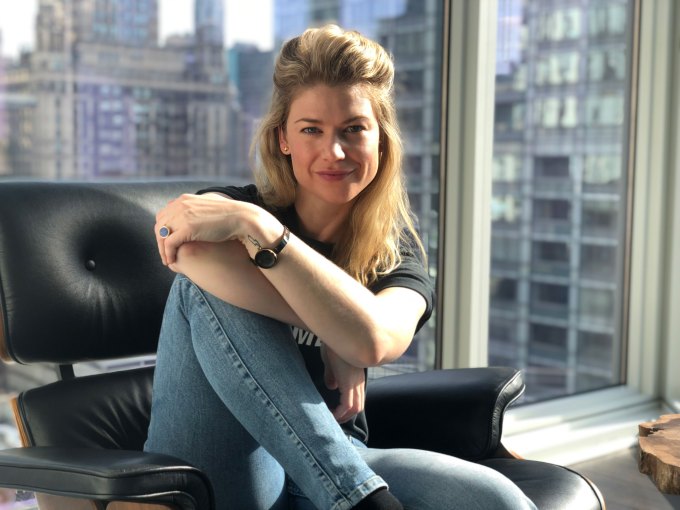
After spending a decade working at international design and branding agencies, Kristine Arth launched her own independent branding agency called Lobster Phone last April. Since then, she’s launched 22 brands under her unofficial tagline “I don’t sleep.” Lobster Phone, however, is all about creating iconic brands with bold personality, which Kristine passionately delivers to her clients. We spoke to Kristine about her branding philosophy, the story behind the name Lobster Phone, and why she loves working with founders.

On working with founders:

“My specialty is people, honestly. I don’t find that I focus in any category, field, or particular segment of an industry is my focus. My specialty is working with people and understanding their background because entrepreneurs have a very different outlook on life. They will climb that mountain at all costs, and I feel very similarly. My sign is Capricorn, I’m a goat. So I will always climb to the top of that mountain. I feel very in line with entrepreneurs in that way because I want to help them do their best work.”

“Kristine is what every person dreams of in a design partner to give your brand a soul and heart.” Julián Ríos Cantú, México City, Mexico, Co-founder and CEO, Eva Tech

On common startup mistakes:

“Entrepreneurs will come to me and say, “I want a logo, I want a campaign, I want this.” And I will say, you need a brand, you need strategy, you need a foundational promise to sell to your clients. And with that foundational brand strategy and a flexible brand, we’ll get what you want. The common mistake is to come with a solution versus coming in with the problem.”

Below, you’ll find the rest of the founder reviews, the full interview, and more details like pricing and fee structures. This profile is part of our ongoing series covering startup brand designers and agencies with whom founders love to work, based on this survey and our own research. The survey is open indefinitely, so please fill it out if you haven’t already.


The Interview

Yvonne Leow: Can you tell me a little bit about yourself and how you got into branding?

Kristine Arth: I originally thought I was going to be a ceramist. I went to school at Columbia in Chicago, and studied ceramics for about half a semester before I discovered the computer lab, and was like “Oh my God, everything is happening so fast there, this is amazing. It’s for me.” So I quickly moved into graphic design and never looked back. I started in advertising and marketing, and worked in Chicago for about 10 years at Leo Burnett, Wunderman, and then moved out to San Francisco to start fresh. Fuseproject, a top industrial design and branding agency, reached out to me, had me come in for an interview and the rest is history.

Alexa for Windows 10 PCs goes hands-free

In November, Amazon launched an Alexa app for Windows 10 PCs which allowed PC owners to speak to Alexa in order to set reminders, timers, alarms, create to-dos, track their calendar, control their smart home get news, information and more, and even play music. Now, that app is getting an update — amid Microsoft’s suite of Build announcements, Amazon has released a new version of the Alexa app for Windows that offers a hands-free experience.

That means, explains Amazon, you can now invoke Alexa whether it’s running in the foreground or the background. All you need to do is to say “Alexa” thanks to the new wake-word capability.

The hands-free option doesn’t replace the former push-to-talk capability. That’s still an option, if you prefer.

In addition to the new hands-free feature, the app now includes support for Pandora music streaming, allowing Windows PC owners to use Alexa to ask for their favorite Pandora stations.

The app represents another way that the Alexa experience has become untethered from Amazon Echo’s speakers, as well as a way for the voice assistant to be used in a more productivity focused environment.

The Alexa app for Windows 10 PCs will automatically update when it’s opened, Amazon says. The app is a free download from the Windows Store.  

OnePlus CEO Pete Lau will discuss the future of mobile at Disrupt SF

Founded in late 2013, OnePlus did the impossible, coming seemingly out of nowhere to take on some of the biggest players in mobile. The company has made a name by embracing a fawning fanbase and offering premium smartphone features at budget pricing, even as the likes of Samsung and Apple routinely crack the $1,000 barrier on their own flagships.

OnePlus’ history is awash with clever promotions and fan service, all while exceeding expectations in markets like the U.S., where fellow Chinese smartphone makers have run afoul of U.S. regulations. The company’s measured approach to embracing new features has won a devoted fantasied among Android users.

Over the past year, however, the company has looked to bleeding edge technology as a way forward. OnePlus was one of the first to embrace In-Display fingerprint sensors with last year’s 6T and has promised to be among the first to offer 5G on its handsets later this year.

CEO Pete Lau formed the company with fellow Oppo employee Carl Pei, with funding from the Chinese smartphone giant. The pair have turned the company into arguably the most exciting smartphone manufacturer in the past decade. OnePlus has big plans on the horizon, too, including further expansion into the Indian market and the arrival of its first TV set in the coming year.

At Disrupt SF (which runs October 2 to October 4), Lau will discuss OnePlus’ rapid accent and its plans for the future.

Tickets are available here.

https://tcprotectedembed.com/protected-iframe/661cf9b1b8f85f5aae09b8946cafadba

( function() {
var func = function() {
var iframe = document.getElementById(‘wpcom-iframe-661cf9b1b8f85f5aae09b8946cafadba’)
if ( iframe ) {
iframe.onload = function() {
iframe.contentWindow.postMessage( {
‘msg_type’: ‘poll_size’,
‘frame_id’: ‘wpcom-iframe-661cf9b1b8f85f5aae09b8946cafadba’
}, “https:\/\/tcprotectedembed.com” );
}
}

// Autosize iframe
var funcSizeResponse = function( e ) {

var origin = document.createElement( ‘a’ );
origin.href = e.origin;

// Verify message origin
if ( ‘tcprotectedembed.com’ !== origin.host )
return;

// Verify message is in a format we expect
if ( ‘object’ !== typeof e.data || undefined === e.data.msg_type )
return;

switch ( e.data.msg_type ) {
case ‘poll_size:response’:
var iframe = document.getElementById( e.data._request.frame_id );

if ( iframe && ” === iframe.width )
iframe.width = ‘100%’;
if ( iframe && ” === iframe.height )
iframe.height = parseInt( e.data.height );

return;
default:
return;
}
}

if ( ‘function’ === typeof window.addEventListener ) {
window.addEventListener( ‘message’, funcSizeResponse, false );
} else if ( ‘function’ === typeof window.attachEvent ) {
window.attachEvent( ‘onmessage’, funcSizeResponse );
}
}
if (document.readyState === ‘complete’) { func.apply(); /* compat for infinite scroll */ }
else if ( document.addEventListener ) { document.addEventListener( ‘DOMContentLoaded’, func, false ); }
else if ( document.attachEvent ) { document.attachEvent( ‘onreadystatechange’, func ); }
} )();

U.S. digital advertising exceeded $100B in 2018 (IAB report)

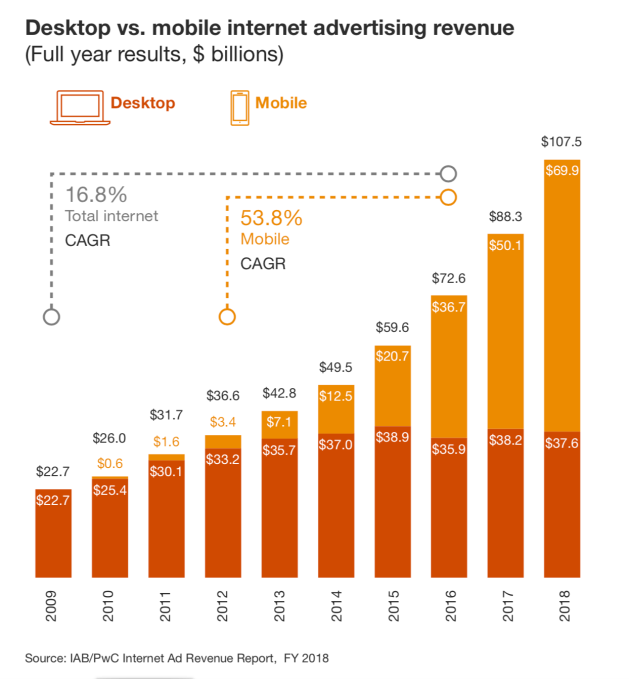
Digital ad spending in the United States exceeding $100 billion for the first time last year, according to the latest internet advertising report from the Interactive Advertising Bureau and PricewaterhouseCoopers.

Specifically, total domestic spending reached $107.5 billion, a 22 percent increase from 2017. Mobile advertising has become increasingly dominant, growing 40 percent year-over-year, to $69.9 billion. And video ad spending grew 37 percent to $16.3 billion.

Sue Hogan, the IAB’s senior vice president of research and measurement, said that in the past, mobile ad spend has lagged behind time spent on those devices. But now, she said, “That parity is almost being reached. Eyeballs are being followed by dollars.”

PwC partner David Silverman acknowledged that this leads to an obvious follow-up: Once ad dollars catch up to consumer attention, will growth slow? In Silverman’s view, “the industry has found ways to evolve” in the past, and it will again.

Internet Advertising Report

“There’s other shifts that are occurring now,” he added, pointing to the growth in digital audio advertising (up 23 percent to $2.3 billion), as well as other areas like out-of-home advertising and bringing ads to new devices.

One of the recurring concerns about the digital ad industry is its dominance by Facebook and Google. While the IAB report doesn’t single out specific companies, it does measure concentration in terms of how much spending is going to the top 10 ad sellers. In 2018, those sellers collected 77 percent of total spending — the IAB says the percentage has fluctuated between 69 percent and 77 percent in the past decade.

As for the effect of GDPR and other privacy regulation, Silverman said, “It certainly will have a significant impact, particularly on the use of data and AI in making advertisements more relevant and more effective” — but he suggested it’s too early to say precisely what the financial impact will be.

Hogan suggested that the California Consumer Protection Act could be more influential on U.S. ad spend. The IAB (which is a trade group representing online advertisers and publishers) has been advocating for federal regulation, rather than a state-by-state approach.

“I hope that we don’t get to the point where it becomes a strain on the industry,” she said. “I think more and more education is needed around that.”

Facebook is being sued by a Polish drug prevention group over free speech violation

Facebook’s efforts to shut down harmful and malicious content on its platform have landed it in a European courtroom, after an anti-drug abuse organization in Poland claimed that a freeze on its Facebook Pages is a violation of its rights to free speech.

The Civil Society Drug Policy Initiative (Społeczna Inicjatywa Narkopolityki in Polish, which goes by the slightly unfortunate abbreviation of ‘SIN’) says that it has filed a complaint with the District Court of Warsaw against Facebook for violating articles 23-24 of the Polish Civil Code, which ensures free speech for individuals and organizations.

SIN says that Facebook deleted several of its pages on Facebook and Instagram for violating its community standards in 2018 and 2019 (here, here, here, herehere, and one page that appears to have been claimed by someone else in the interim). Another page SIN set up after the others were shut down appears to still be up for now.

SIN is asking for Facebook to reinstate its Pages and its followers, and to apologise publicly for its actions.

When contacted for a response, Facebook declined to comment on the case.

SIN describes itself as a Polish NGO that runs educational activities to make people aware of the harmful consequences of drug use, and provides assistance to people drug abusers.

The group is being supported in its legal action by lawyers working pro-bono with a Polish non-profit called Panoptykon, which was set up in 2009 to find and help fight cases against tech companies where it believes personal rights are being violated in our current “surveillance society” (its description, and also the reason for the panopticon reference).

Panoptykon is a busy group these days: another case that it filed against Google and the IAB in Poland over targeted advertising recently got referred up to the authorities in Ireland (where many cases are heard as a result of the country being home to many global HQs) and Belgium (home of the European Commission.

It’s not exactly clear what Facebook found offensive in SIN’s content since Facebook declined to respond.

From the looks of it, SIN itself does not take your typical “don’t do drugs” approach but instead focuses on the concept of harm reduction. It sets up a presence at clubs, festivals and other events where people might take recreational drugs. Then, it “leave[s] the assumption that it’s best not to start using drugs, or to stop if you do so [since] it’s not always possible. If you are already using, we educate on how to do it with least damage possible.” It also offers methods for testing drugs and advice on what different drugs can do.

SIN notes that the UN, the EU, the National Bureau for the Prevention of Drug Addiction; Red Cross; Doctors Without Borders and many others support this approach.

However, it may be that its native approach appeared to Facebook’s algorithms as similar to groups that advocate using drugs. Alternatively, it may be that Facebook regarded SIN as taking a particular approach on a controversial subject — the best way to cope with illegal drug use — which would have run afoul of its guidelines. “The main goal of our action is to make sure that regardless of what decisions you make at parties, you have fun and keep it safe,” SIM notes on its site.

Social media platforms have come under fire for how their efforts to contain malicious or harmful content occasionally backfire by sometimes penalising more innocent accounts by mistake. Similarly, there have been accusations that rules designed by regulators to prevent harmful content on social media are partly responsible for the platforms mandating particularly stringent controls, which ironically end up violating the exact rights that regulators are trying to ensure, like free speech.

Facebook — which has had its share of heat from European regulators over issues like violations of personal privacy, data breaches, and the role it plays in helping to police its platform against abuses and misuse in democratic processes — has been working to improve the nuance of its controls, by making it more transparent to users when it has taken certain actions like shutting down pages or blocking content, and why. Panoptykon says that it believes this legal action, if successful, could help that evolution along.

“We hope that SIN vs Facebook will incentivize the portal to make further changes and implement ‘due process,’ thus establishing the standards also for other platforms,” Panoptykon notes. “In addition, with SIN vs Facebook we strive not only to persuade the platforms to create better internal procedures, but also to ensure that users who do not agree with their decisions can challenge them before an independent, external body, such as a court.”


FBI has seized Deep Dot Web and arrested its administrators

The FBI have arrested several people suspected of involvement in running Deep Dot Web, a website for facilitating access to dark web sites and marketplaces.

Two suspects were arrested in Tel Aviv and Ashdod, according to Israel’s Tel Aviv Police, which confirmed the arrests in a statement earlier in the day, Local media first reported the arrests. 

Arrests were also made in France, Germany, the Netherlands, and Brazil.

Deep Dot Web is said to have made millions of dollars in commission by offering referral links to dark web marketplaces, accessible only at an .onion domain used specifically by the Tor anonymity network. Tor bounces internet traffic through a series of random relay servers dotted across the world, making it near-impossible to trace the user.

Its .onion site displayed a seized notice by the FBI, citing U.S. money laundering laws. Its clear web domain no longer loads.

Tuesday’s arrests follow an earlier operation by U.S. and German authorities earlier in the week that took down the Wall Street Market, one of the largest remaining dark web marketplaces. Thousands of sellers sold drugs, weapons and stolen credentials used to break into online accounts.

Efforts to reach Deep Dot Web over encrypted chat were unsuccessful.

Spokespeople for the Justice Department and the FBI did not immediately comment. A spokesperson for the Israeli consulate in New York did not respond to a request for comment.