Fli Charge Technology acquired by Birch Lake to accelerate a wireless future

Fli Charge Technology is today announcing it was acquired by an affiliate of Birch Lake Associates. As part of the purchase, industry veteran Khalid Zitouni is taking offer the chief executive position as the company looks to expand its reach for Fli Charge’s clever power delivery technology.

TechCrunch first spied Fli Charge at CES 2018 when the company demonstrated its tech with Craftsman power tools. Once a Fli Charge device is placed on the strip, charging starts immediately at the same rate as if it was plugged into an outlet. Four small conductive nubs make contact with the pad and serve up power as needed. The system is capable of simultaneously charging batteries of different voltages. One strip can charge a smartphone, power tool, and laptop at the same time even though each device has different power requirements.

Fli Charge tech could bring the convenience wireless charging to new industries. That’s where Birch Lake comes in.

“The FLI Charge technology is a clear outlier in the power and charging space,” said FLI Charge’s incoming Chief Executive Officer, Khalid Zitouni. “While it resembles wireless charging solutions on the market today, it is not constrained by the limitations that have held back those technologies from garnering significant market adoption or expanding into new product categories. We are excited to rapidly expand our consumer product offerings and continue to develop a robust licensing platform for all portable products including power tools, IOT devices, drones, audio products and small appliances, among others.”

Zitouni is taking over for former Fli Charge CEO, Cliff Weinstein, who is staying on as company consultant. In 2016 Weinstein led a management buyout to take Fli Charge private and eventually debut an early version of the product on Indiegogo in 2017.

When I spoke to Weinstein at CES 2018 he was optimistic about a future where Fli Charge’s technology was built into desks and tool boxes, allowing office workers and construction workers alike to live a cord-free life. Now, with Birch Lake taking the company forward, that future could be near than ever. Fli Charge’s implementation of wireless power delivery is impressive and adopted by the market, could lead to a truly wireless future.

Fli Charge demonstration at CES 2018


Journey launches its real-time group “Peloton For Meditation”

Sitting silently with your eyes closed isn’t fun but it’s good for you…so you probably don’t meditate as often as you’d like. In that sense it’s quite similar to exercise. But people do show up when prodded by the urgency and peer pressure of scheduled group cycling or aerobics classes. What’s still in the way is actually hauling your lazy butt to the gym, hence the rise of Peloton’s in-home stationary bike with attached screen streaming live and on-demand classes. My butt is particularly lazy, but I’ve done 80 Peloton rides in 4 months. The model works.

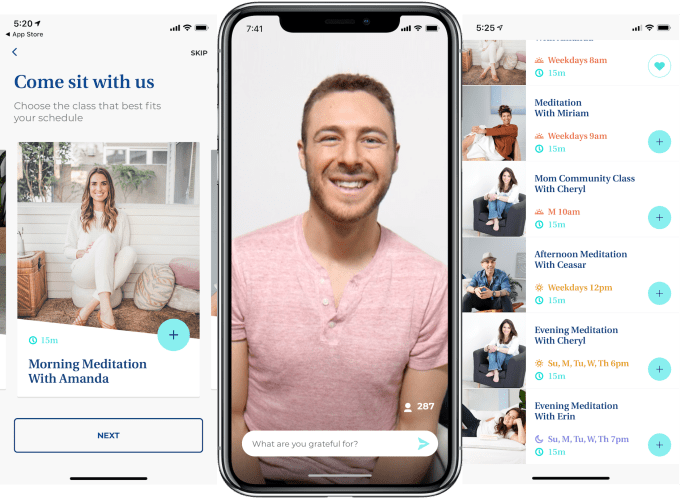
Now that model is coming to mindfulness with the launch of Journey LIVE, a subscription app offering live 15-minute group meditation classes. With sessions starting most waking hours, instructors that interact with you directly, and a sense of herd mentality, you feel compelled to dedicate the time to clearing your thoughts. By video and voice, the teachers introduce different meditation theories and practices, guide you through, and answer questions you can type in. Each day, Journey also provides a newly recorded on-demand session in case you need a class on your own schedule.

“‘I tried Headspace’ or ‘I tried Calm’ . With a lot of the current meditation apps, people go on but they drop off very quickly” says Journey founder and CEO Stephen Sokoler. “It means that there’s an interest in meditating and having a better life but people fall off because meditating alone is hard, it’s confusing, it’s boring. Meditating with a live teacher who can connect with you and say your name, who makes you feel seen and heard makes huge difference.”

Journey subscriptions start at $19.99 per month after a week-long free trial. That feels a bit steep, but prices drop to $7.99 if paid annually with the launch discount, or you can dive in with a $399 lifetime pass. The challenge will be keeping users from abandoning meditation and then their subscription without resorting to growth hacking and annoying notifications that are antithetical to the whole concept. Journey has now raised a $2.4M seed round led by Canaan and joined by Brooklyn Bridge Ventures, Betaworks, and more to get the company rolling.

Sokoler’s own journey could set an example of the possibilities of sticking with it. “Meditation changed my life. I was fortunate enough to move to Australia, find a book on Buddhism, and then I had the willpower to start practicing meditation every day” he tells me. “I lost 85 pounds. People ask me how I lost the weight and they expect me to say a diet like keto or Atkins, but it was because of the program I was in.” Suddenly able to sit quietly with himself, Sokoler didn’t need food to stay occupied or feel at ease.

The founder saw the need for new sources of happiness while working in employee rewards and recognition for 12 years. He built up a company that makes momentos for commemorating big business deals. Meditation proved to him the value of developing inner quiet, whether to inspire happiness, calm, focus, or deeper connections to other people and the world. Yet the popular meditation apps ignored thousands of years of tradition when meditation would be taught in groups that give a naturally ethereal activity more structure. He founded Journey in 2015 to bring meditation to corporate environments, but now is hoping to democratize access with the launch of Journey LIVE.

“You could think of it as a real-life meditation community or studio in the palm of your hand” Sokoler explains. Instructors greet you when you join a session and can give you a shout-out for practicing multiple days in a row. They help you concentrate on your breath while giving enough instruction to keep you from falling asleep. You can see or hide a list of screen names of other participants that make you feel less isolated and encourage you not to quit.

Finding a market amidst the popular on-demand meditation apps will be an uphill climb for Journey LIVE. While classes recorded a long time ago might not be as engaging, they’re convenient and can dig deep into certain styles and intentions. Calm and Headspace run around $12.99 per month, making them cheaper than Journey LIVE and potentially easier to scale.

But Sokoler says his app’s beta testing saw better retention than competitors. “If you’ve ever been to the New York Public Library, there’s so many books versus going to a local curated bookstore where something is right there for you. This is much more approachable, much more accessible” Sokoler tells me. “There’s a paradox of choice and having so many options makes it hard for people to stick with it and come back every single day.”

With our phones and Netflix erasing the downtime we used to rely on to give our brain a break or reflect on our day, life is starting to feel claustrophobic. We’re tense, anxious, and easily overwhelmed. Meditation could be the antidote. Unlike with cycling or weightlifting, you don’t need some expensive Peloton bike or Tonal home gym. What you need is consistency, and an impetus to slow down for fifteen minutes you could easily squander. We’re a tribal species, and live group classes could use camaraderie to lure us into the satisfying void of nirvana.

Serverless monitoring startup Espagon expands to cover broader microservices

When Espagon launched last Fall, the Israeli startup had an idea to monitor serverless, architectures, specifically AWS Lambda. But the company didn’t want to confine itself to monitoring a narrow class of applications, and today it announced it is now able to monitor a broader set of microservice development approaches.

CEO and co-founder Nitzan Shapira says when it launched, the startup wanted to take aim at serverless and Lambda seemed to be the prime tool for doing that. “Our product was basically a tracing, troubleshooting and monitoring tool that was automatically doing all of that for the Lambda ecosystem. And and since then, we’ve seen actually a bigger shift [beyond] just Lambda,” he said.

That shift was to a broader view of this kind of deployment across a set of modern applications involving microservices. When developers move to these modern approaches, it becomes impossible to launch an agent to help monitor what’s happening. Yet the developers still need visibility into the applications.

To help, the company is launching a tracing and logging tool together, a first for this type of monitoring, according to Shapira. “Today, with engineering and DevOps working closer than ever, being able to automatically trace microservices applications without using an agent and combine the tracing and the logging in one platform is extremely valuable,” he said.

Shapria says that over time the company plans to expand this idea and support more frameworks out of the box to allow this kind of open tracing across different tools. “We need to provide support for more and more frameworks becoming popular. Lambda is just one framework,” he explained.

Serverless is somewhat of a misnomer. The servers are still there, but instead of programming to launch on a particular server, virtual machine (VM) or set of VMs, the cloud infrastructure vendor provides whatever infrastructure resources a developer requires at any given moment automatically.

Microservices encompass the idea that instead of building a monolithic application, you break it down into a series of smaller services, typically launching them in containers and orchestrating the containers in a tool like Kubernetes.

The company only came out of stealth last October, so it’s still early days, but it is already expanding, opening a sales office in the US with a 4-person staff. The engineering team remains in Israel. It is approaching 20 employees in total.

Shapria wouldn’t talk about exact customer numbers, but says the company has hundreds of users now and is doubling the number of paying customers every month.

Freedom Mobile server leak exposed customer data

A security lapse at Canada’s fourth largest cell network Freedom Mobile exposed customer data.

Security researchers Noam Rotem and Ran Locar found an Elasticsearch server leaking five million logs containing customer data. The server wasn’t protected with a password, allowing anyone to access the data.

Rotem and Locar, who shared their findings exclusively with TechCrunch and published his report at vpnMentor, said it took the cell giant a week to secure the leaking database after first reaching out.

The database is believed to be part of a logging system used by the company to determine errors and glitches in the company’s systems. The database recorded any errors and the plaintext data associated with it, including customer data.

Data seen by TechCrunch reveals customer names, email addresses, phone numbers, postal addresses, dates of birth, customer types, and Freedom Mobile account numbers.

The logs also answers to credit checks filed through Equifax, including details if an application was accepted or rejected — along with the reason why.

We also found full credit card numbers, expiry dates and verification numbers stored in plaintext.

None of the data was encrypted.

Freedom Mobile has more than 1.5 million customers across Canada, according to its latest financial earnings. Chethan Lakshman, a spokesperson for Freedom Mobile’s parent company Shaw Communications, said about 15,000 customers were affected.

“We have discovered that the data that was exposed was contained to a very small number of customers who had opened or made any changes to their accounts at 17 Freedom Mobile retail locations from March 25 to April 15, and any customers who made changes or opened accounts on April 16,” he said. “Our investigation has revealed that a very limited amount of Freedom Mobile customer data was exposed as the result of a misconfigured server managed by Apptium, a new third-party service provider Freedom Mobile has engaged to streamline our retail customer support processes.”

A forensic investigation is underway, the spokesperson said.

Apptium did not return a request for comment.

It’s the latest in a string of data exposures following security lapses that failed to secure databases with basic security measures. Earlier this year, Rotem and Locar found Chinese online shopping giant Gearbest inadvertently exposed millions of customer orders. Now, the researchers say the Freedom Mobile data leak could be one of Canada’s largest. The closest was Bell Canada’s data breach in 2017, in which hackers took more than 1.9 million customer records.

Access to credit card data and credit score data would be a boon for fraudsters and identity thieves wanting to cash in.

A spokesperson for Canada’s data protection authority, the Office of the Privacy Commissioner, confirmed it “received a breach report related to Freedom Mobile,” and “will be examining the report in order to determine next steps.”

Read more:

GM Cruise raises $1.5B at a $19B valuation from Softbank and Honda

GM Cruise has raised another $1.5 billion in new equity from a group of investors that includes T. Rowe Price Associates, Honda, Softbank Vision Fund and its parent company GM as the self-driving vehicle company pushes to launch a commercial autonomous ride-hailing service this year.

This investment increases Cruise’s post-money valuation to $19 billion, inclusive of SoftBank’s previously announced investment commitment. Cruise has secured capital commitments totaling $7.25 billion in the past year, according to the company.

“Developing and deploying self-driving vehicles at massive scale is the engineering challenge of our generation,” said Cruise CEO Dan Ammann . “Having deep resources to draw on as we pursue our mission is a critical competitive advantage.”

GM Cruise has one of the most aggressive timelines among companies hoping to deploy a commercial self-driving vehicle service. GM’s self-driving unit has stuck to its previously stated timeline to launch a commercial service “sometime in 2019.”

Cruise has grown from a small startup with 40 employees to more than 1,000 today at its San Francisco headquarters.

And Cruise isn’t curtailing that rate of growth; it’s accelerating it.

Cruise announced in November plans to expand to Seattle, in pursuit of more engineering talent to develop its technology. GM Cruise aimed to hire between 100 to 200 engineers by the end of 2019. The company, now led by Ammann, who left his post as president of GM to take the job, plans to hire at least 1,000 more engineers and other personnel by the end of the year. (Kyle Vogt, a Cruise co-founder who was CEO and also unofficially handled the chief technology officer position, is now president and CTO.)

Arden Hoffman, who helped scale Dropbox, left the file-sharing and storage company to head up human resources at Cruise and help the company scale quickly.

The GM subsidiary is expanding its office space in San Francisco to accommodate the growth. GM Cruise will keep its headquarters at 1201 Bryant Street in San Francisco. The company will also take over Dropbox headquarters at 333 Brannan Street some time this year, a move that will triple Cruise’s office space in San Francisco.

GM Cruise received a $2.25 billion investment by SoftBank’s vision fund in May 2018. That first Softbank investment was cut into two parts with the first tranche of $900 million made at the closing of the transaction. Once Cruise’s autonomous vehicles are ready for commercial deployment, Softbank will complete the second investment of $1.35 billion, the companies said at the time.

A few months later, Honda committed $2.75 billion as part of an exclusive agreement with GM and Cruise to develop and produce a new kind of autonomous vehicle.

As part of that agreement, Honda will invest $2 billion into the effort over the next 12 years. At the time, Honda made an immediate and direct equity investment of $750 million into Cruise. Honda’s investment gives the automaker a 5.7 percent stake in Cruise.

Facebook unveils an automated ad builder and an appointment manager for small businesses

Facebook said it’s launching a number of new products aimed at small businesses today — which is appropriate, since we’re currently in the middle of National Small Business Week.

These new features include Automated Ads, which Director of Product Management Nikila Srinivasan said are “really built for small businesses that are one- to two-person businesses with very little marketing expertise.”

The idea is that business owner can answer a few questions about what kind of company they are and about their goals are for the campaign. Then based on their answers — as well as the information on their Facebook Page — Facebook will create recommendations for the audience they should target, the budget they should set and even how the different versions of the ad should look and what they should say.

Small businesses can still buy ads the way they did before, but even if they go the Automated Ads route, they don’t have to accept Facebook’s recommendations. They can set their own budget, for example, and Facebook will predict the results. These ads can run on Facebook itself, as well as Instagram, Messenger and the Facebook Audience Network.

Facebook Automated Ads

Srinivasan said there’s a “set it and forget it” element to the program, but at the same time Facebook will make sure to keep advertisers alerted to how the campaign is going and “it’s up to the business if they want to come in and be more active.”

“The main thing is, we don’t want there to be guess work, we don’t want there to be expertise needed to use this product,” she said.

And while Facebook said it’s provided lightweight support for booking appointments in Messenger in the past, it’s now expanding that functionality, so businesses can accept appointments and manage all of them appointments through Facebook and Instagram. These appointments can also be synced with the business owner’s personal calendar, or with third-party appointment tools like MyTime and HomeAdvisor.

Lastly, Facebook said it’s rolling out new video editing capabilities, making it easier to add text and image overlays to a video, and to automatically crop a video to accommodate the different aspect ratios of different ad environments.

K-Zen Beverage, a nascent cannabis-infused drink brand, has raised $5 million in seed funding

There’s a new cannabis-infused drink company coming together, helped along by the venture firm DCM, which just plugged $5 million in seed funding into the company.

Called K-Zen Beverages, the months-old startup represents the second cannabis-related investment for DCM after Eaze, the on-demand cannabis delivery platform.

So what’s the appeal? The opportunity to unlock a new market, it seems. Though Bay Area-based K-Zen has yet to roll out its first product — it’s working on three drinks that will be sold as shots and come in lemon chamomile, pink lemonade, and wild berry favors — there aren’t yet throngs of cannabis-infused brands. At least, it remains an open playing field, and the opportunity that K-Zen is chasing looks to be big.

According to one of the boldest predictions so far — unsurprisingly, it’s one that cannabis startups and investors love to cite — the investment bank Canaccord Genuity recently posited by marijuana-infused beverages could hit $600 million in the U.S. by 2022.

Many cannabis-infused beverages, including beer, still lack the psychoactive compound THC because of regulations around it. Companies have instead been infusing their drinks with CBD, a compound that can be derived from both cannabis and hemp plants and that has taken off since industrial hemp cultivation was made legal in the United States last year.

But things are changing quickly. Though pot remains illegal at the federal level, 34 states have now legalized medical or recreational marijuana, and more are expected to join their ranks. That largely explains the timing of a startup like K-Zen — whose name blends ‘kaizen,’ a Japanese philosophy of continuous improvement, and ‘zen,’ a state of calm originally associated with Zen Buddhism. More to the point, it explains why K-Zen isn’t steering clear of THC but will instead sell one drink that features it exclusively, and sells blends of CBD and THC with the others.

As explains cofounder and co-CEO Judy Yee — a veteran of numerous packaged goods and health and wellness companies — K-Zen is looking to target people like herself, a busy working mother was looking for new ways to “bring joy into an active lifestyle.”

In fact, it was after Yee tried topicals, then some experimental beverages, that she shared how much she liked both with a friend who also follows emerging trends and who Yee had crossed paths with at numerous jobs over the years, As luck would have it, that friend, branding expert Soon Yu, was once funded by DCM. Convinced of this new vision, Yu picked up the phone, shared K-Zen’s vision, and voila, a check was written.

Now, Yee and Yu just have to have the product made — then sell it.

Yee says K-Zen is on target to rollout its beverages this summer, where they will be made available in dispensaries, beginning in California, and directly to consumers via its site.

The five-person startup may have to educate customers first. The reason: marijuana-infused foods typically take at least an hour to kick in, making it harder for consumers to accurately dose themselves.

“People know what a glass of wine does to them, but [we may] create a pictogram that helps people understand if i drink this” what will happen and when, says Yee, acknowledging the challenge.

At least some of its customers may at least tried a cannabis drink by then, given how quickly people are gravitating to new cannabis products. Though K-Zen is early to the game, it is not alone. For example, a Seattle company, Trukino, already makes both THC and CBD varieties of apple cider. Another company, California Dreamin,’ sells TCH-infused sodas that taste like tangerine.

Tencent promises its technology will ‘do good’

Tencent, one of Asia’s most valuable companies with a current market cap of around $460 billion, has introduced a new motto after co-founder and CEO Pony Ma said this week he wanted ‘tech for good’ to be part of the company’s vision and mission in the future.

The company has not yet officialized the new corporate philosophy and it’s unclear how the “don’t be evil”-like slogan will manifest in Tencent’s business strategy. Nor do we know if it will replace the old mission, which is still emblazoned on its website:

Tencent’s mission is to “improve the quality of life through internet value-added services”. Guided by its “user oriented” business philosophy, Tencent achieves its mission via the delivery of integrated internet solutions to over 1 billion netizens.

Episodes of recent events can probably provide some hints to what the new slogan might entail. The old mission, which focuses on the individual user rather than the wider society, has led Tencent to supremacy in video games and social media; the company is the operator behind the billion-user messager WeChat and several top-grossing video games. But these segments of businesses are under growing pressure as China’s changing regulatory environment and industry rivals create challenges for the 21-year-old behemoth.

A months-long gaming freeze last year put a squeeze on Tencent’s gaming revenues, wiping billions of dollars from its market cap. Rising short-video app Douyin, which is TikTok’s local version, threatens Tencent’s dominance in the social and content realms.

To stay competitive, the company underwent a sweeping re-organization last October to place more focus on enterprise businesses, such as cloud computing and other digital infrastructure for industries ranging from finance, healthcare, education to government services.

The new focus to upgrade entrenched industries not only opens up more revenue streams; these sectors also provide the testing ground for Tencent to put its ‘tech for good’ mission into practice.

As Ma pledged at the government-run industry conference Digital China Summit on Monday, Tencent believes “technology can bring benefits to the human race; humans should make good use of technology and refrain from its evil use; and technology should strive to solve the problems it brings to society.”

Ma pointed to three key areas where technology can generate positive changes: traditional industries, where Tencent could provide big data capabilities to beef up efficiency in production; government units, where Tencent could leverage its apps to digitize a slew of civil services such as applying for visas and renewing drivers’ licenses; and society, which is a broad and arguably vague definition but has seen efforts like tracing missing children using Tencent’s face recognition solutions.

“Looking at parallels across the globe, Google proposed ‘do no evil’ as its code of conduct ahead of its initial public offering 20 years ago. I think this kind of elevated mission is evidence of the amount of influence a company has accumulated,” Zhong Xin, a former Qualcomm engineer who founded the artificial intelligence-powered medical imaging startup 12 Sigma, said to TechCrunch.

“Technology is a double-edged sword. A company needs a guiding principle to determine its proper use, so I believe the purported mission to do good with technology is inevitable,” added Xin.

From the government’s standpoint, a corporate motto that focuses on doing good is clearly music to the ears. Tencent’s new code of conduct comes as China’s tech darlings face mounting public and government criticisms for their adverse impact on society, a movement mirroring Silicon Valley’s tech backlash. The charges range from video games’ role in causing bad eyesight among children, which put Tencent in the crosshairs; to clickbait content running rampant on Bytedance’s popular news app, Toutiao.

“‘Doing good’ should be an inherent value to all technology companies, including venture investors,” Wang Jing, partner at venture capital firm Sky9 Capital, suggested to TechCrunch. “When companies have to single out ‘doing good’ on a special occasion, it may be that something has already gone wrong.”

Many tech heavyweights in question have responded to backlashes by imposing stricter policies over their products. Tencent, for example, launched an underage-protection mode for all its gaming titles that would allow parents to monitor children’s play time. Toutiao, too, has hired thousands of auditors to root out content deemed inappropriate by the authority.

This is not the first time Tencent has weighed in on its own ethics. The phrase ‘tech for good’ was first unveiled by Tencent co-founder and former CTO Tony Zhang in early 2018, but it has probably garnered more attention among the executives after an essay titled “Tencent has no dream” sparked heated debate in the Chinese tech circle. Penned by a veteran journalist, the article argued that Tencent was fixated on seeking investment-worthy products rather than inventing its own.

“People argued that Tencent has no dream. By bringing up the slogan ‘tech for good’, Tencent seems to be proclaiming to the public that it does have a dream,” Derek Shen, who is chairman at shared housing startup Danke and formerly headed LinkedIn China, told TechCrunch. “And its dream is big, which is to do good things to people’s lives.”

Hubtype raises $1.1M to help developers build richer chat support

Barcelona-based Hubtype has raised a €1 million (~$1.1M) seed round led by Madrid-based early stage VC firm, K Fund. The team last raised when the business was founded, back in February 2016, when they took in €235,000 in a mix of public and angel funding.

Hubtype targets enterprises and developers with customer service focused tools to help build and scale what it describes as “conversational messaging experiences” — aka messaging interfaces that go beyond more basic chatbot-style offerings to support richer interactions and ‘smart’ automation, such as knowing when to hand off to a human agent.

“We know very well that chatbots aren’t enough on their own, as we’ve been building bots for three years. To provide effective and meaningful interactions, companies need to go beyond bots and provide conversational experiences: Micro-apps within the messaging channels that everyone uses daily,” say co-founders, Eric Marcos and Marc Caballé, explaining the wider context around the space as they see it.

“Conversational experiences take the best of chat (conversational user interfaces) and combine elements of graphical user interfaces like websites, apps, etc. Effective ones aggregate AI, decision trees, webviews, human agent hand-off and more. Furthermore, enterprise companies need integration with other APIs and systems, from back-end inventory and order tracking to booking engines, analytics, NLP services and more.”

They argue that orchestrating all these different elements can be “extremely difficult and time-consuming” for businesses lacking a dedicated tech team to handle building and maintaining smooth chat-based customer interactions.

That’s where Hubtype sees an opportunity to elbow in, starting with a b2b focus but aiming to tilt fully at developers over the long term.

Hubtype’s opensource framework for building conversational apps, called Botonic, is based on React.js. Using this it claims a single developer can build, deploy and scale conversational apps across multiple messaging channels (including webchat) — doing away with the need for a full dev team to build and maintain everything.

The team’s goal is to become “the reference platform” for developers to create conversational apps using React.js. Some of the seed funding is therefore pegged for building out Hubtype’s developer relationship program, as well as ploughing into product development and scaling the sales team.

“We’re currently a b2b company and our target customers are enterprise-level companies mainly in banking, insurance and e-commerce/retail,” the co-founders note, adding: “Eight out of more than 20 customers are in the Forbes Global 2000 List, with some ranking in the top 20 such as Volkswagen, Inditex, HP, and Bankia.”

“With this funding round we’re investing in further developments of our framework, including AI capabilities which will allow clients to train their chatbot in one language and roll out automatically in about 100 languages. We’ll also be building our developer relationship program and scaling our sales team,” adds  Caballé in a statement.

Hubtype tells us it expects to reach 100 customers this year — though they’re not disclosing exact customer numbers yet.

“We have a strong presence in the Spanish enterprise ecosystem and within international brands that operate in Europe. We provide our service globally but we’re currently focused on the EU and testing some emerging markets where WhatsApp is prevalent, as we are one of the few official solution providers for the platform globally,” the co-founders add.

Asked about the competitive landscape, Hubtype names Accel-backed Rasa as an “AI centric” bot-builder framework rival with a similar “bottom up” focus on marshalling developers to build adoption.

Another competitor the co-founders point to is Botpress, saying it has a somewhat similar approach while flagging a different business model (focused on “consulting/services centric”).

Microsoft Bot Framework and Dialogflow are two other rival frameworks they name — but again the suggestion is both are AI centric, rather than supporting a richer mix of conversational components.

“The difference between us and our closest competition is that we have a very clear niche (React developers) and we are pioneers in advocating for conversational apps (text+GUI and using NLP and AI as elements) rather than AI or NLP-centric experiences. Most of our competitors are focused on AI and NLP,” they add.

“Our tools focus on building applications that sit at the intersection between text-based and graphic interfaces. We take into account NLP, AI, interactive messages, webviews, managing context, human handoffs and multichannel integrations. Additionally, we aggregate more messaging channels than all or most competitors.”

Commenting on the seed raise in a statement, Jaime Novoa, associate at K Fund, added: “The chatbot industry has undergone a major transformation from text to conversational apps, and Hubtype is leading enterprise companies to build the best customer experiences in a scalable way by using automation. Companies must move from traditional phone and email communication and into a new era of multichannel conversational messaging. Hubtype is an important addition to our investment portfolio, and timing is key.”

Announcing the Corvid by Wix Challenge at the TC Hackathon at VivaTech

Hey there hackers, il n’y a pas de temps à perdre! You heard it here first, there’s no time to lose. Today’s the last day you can sign up to compete in the TechCrunch Hackathon at VivaTech 2019 on 17-18 May — days two and three of the conference — in Paris.

Come and join hundreds of the best hackers, coders and programmers in the world to design, hack and create something fantastic in less than two very short, intense days. Who knows? You might even help humanity in the process.

We have multiple sponsored hack contests from which to choose, each one offering its own substantial prize for the best hack (more on that below). Prizes may include cash, incubation, hardware and swag. What’s more, TechCrunch will award a €5000 grand prize to the one team it deems the best overall hack.

Here’s how it all works. Teams of 4-6 people select a challenge during registration. If you don’t already have a team, we’ll find one for you in the onsite matchup session. Teams have just 24 hours to produce a working product, and then they get just 60 seconds to present it onstage to a panel of judges. Keep those caffeine levels amped up.

The judges rank team hacks on a scale of one to five, and the team with the highest score wins the prize associated with the sponsored hack. All teams that receive a combined score of three or higher also win tickets to TechCrunch Disrupt Berlin 2019 and VivaTech 2020.

You’ll need all your skills and stamina to make it across the finish line. It won’t be easy, but it will be fun. And we even provide food — breakfast, lunch, dinner and midnight snacks — throughout the event. That includes plenty of water, tea, coffee and Red Bull, too. Want more details? Read the hack FAQ, and check out the hackathon agenda.

Here’s the latest sponsored challenge you can tackle at the TC Hackathon — Corvid by Wix Challenge:

There are plenty of community, collaboration and project management tools available for developers to use. But how do we make these essential assets better? In this challenge, the team with the best hack that uses Corvid by Wix, an open development platform that lets you build, manage, deploy and scale advanced web applications, will receive a prize worth €5000.

Plus, you can still sign up to hack on one of the other challenges by EDHEC, Eramet, SanofiCegedimIBM and Galeries Lafayette / Publicis Sapient.

The TechCrunch Hackathon at VivaTech 2019 takes place on 17-18 May. Don’t miss out and register for your free ticket. Il n’y a pas de temps à perdre! There’s no time to lose!