Microsoft wants you to work less

Microsoft today announced updates to its MyAnalytics platform and a new Outlook feature that are meant to help you work less, find more time to focus on the work that actually matters and, by extension, get more downtime.

Until now, for example, MyAnalytics, Microsoft’s tool for helping employees track their productivity, would provide you with a measure of how much time you spent working after hours. That’s not necessarily a healthy number to track. Going forward, MyAnalytics will track the number of days you managed to unplug after work and didn’t check your email or work on a document at 8pm (something Microsoft’s own PR department could learn from given that it has a tendency to provide essential press materials for next-day embargoes at 6:30pm). The idea here, obviously, is to get employees to focus on this number instead of how much they work when they are off the clock.

“Our customers often tell us they spend all day in meetings with little time to focus on pressing tasks and projects,” Microsoft communications chief Frank X. Shaw also noted in a press briefing ahead of today’s announcement.

To combat this, the company today launched a few new features that will let you set up regular ‘focus time.’ The first of this is a tool that lets you set up focus time each week, as well as a feature in Microsoft teams that will alert your fellow employees when you are trying to get things done.

Since your colleagues often don’t care about your flow, though, and are prone to scheduling yet another unnecessary meeting during those times, Microsoft is also launching a new AI-powered Outlook plugin that will help you rebook your focus time and find times for focusing on specific to-do items.

In the future, the company also plans to introduce well-being, networking and collaboration plans.

Focus plans will become available in preview in the next few months for Microsoft 365 and Office 365 users, with E5 customers getting them first.

Microsoft’s Chromium-based Edge browser will get new privacy controls, IE mode and Collections

Microsoft today announced a number of new features for its new Chromium-based Edge browser, which saw its first public release only a few weeks ago. One of these features addresses some worries from business customers, who need compatibility with the old pre-Edge Internet Explorer, in addition to new privacy controls and an interesting new take on bookmarks.

The feature that users will likely care most about here is Collections, which Microsoft describes as a way to address “the information overload customers feel with the web today.” With Collections, users can collect, organize and share content from across the web. This feature will also offer an integration with Microsoft’s Office suite, though the details of how this will work remain unclear.

On the privacy front, Microsoft announced that the new Edge will get three privacy settings: unrestricted, balanced and strict. These settings will influence how third parties will be able to track you across the web.

As far as IE mode goes, this feature shows that Microsoft is still haunted by the legacy of a browser it first launched in 1995 and replaced by the first version of Edge in 2015. Too many businesses still rely on legacy applications that only run on Internet Explorer, so with this IE mode in Edge, users will be able to open legacy sites in what is essentially an IE tab in the new browser.

It still feels weird to say this, but Edge moving to Chromium is probably the most exciting thing to happen to browsers in this space in a long time. Instead of having to focus on trying to make all of the moving parts of the browser engine work, Microsoft now has a chance to put its considerable engineering force to actually develop innovative features for users and, by extension, force its competitors to innovate as well. That vision is slowly coming together now that the company has a stable platform to work from.

For now, this is all Windows 10-only, though. While some expected Microsoft to start releasing the macOS and Linux versions of the new Edge at its Build developer conference today, that did not happen.

Microsoft wants to reinvent documents and collaboration with its new Fluid Framework

At its Build developer conference, Microsoft today announced the Fluid Framework, a new software development kit that is meant to help developers build faster and more flexible distributed applications that will change the way people think about document and collaborative editing. Microsoft itself plans to integrate Fluid into some of its Office 365 applications later this year.

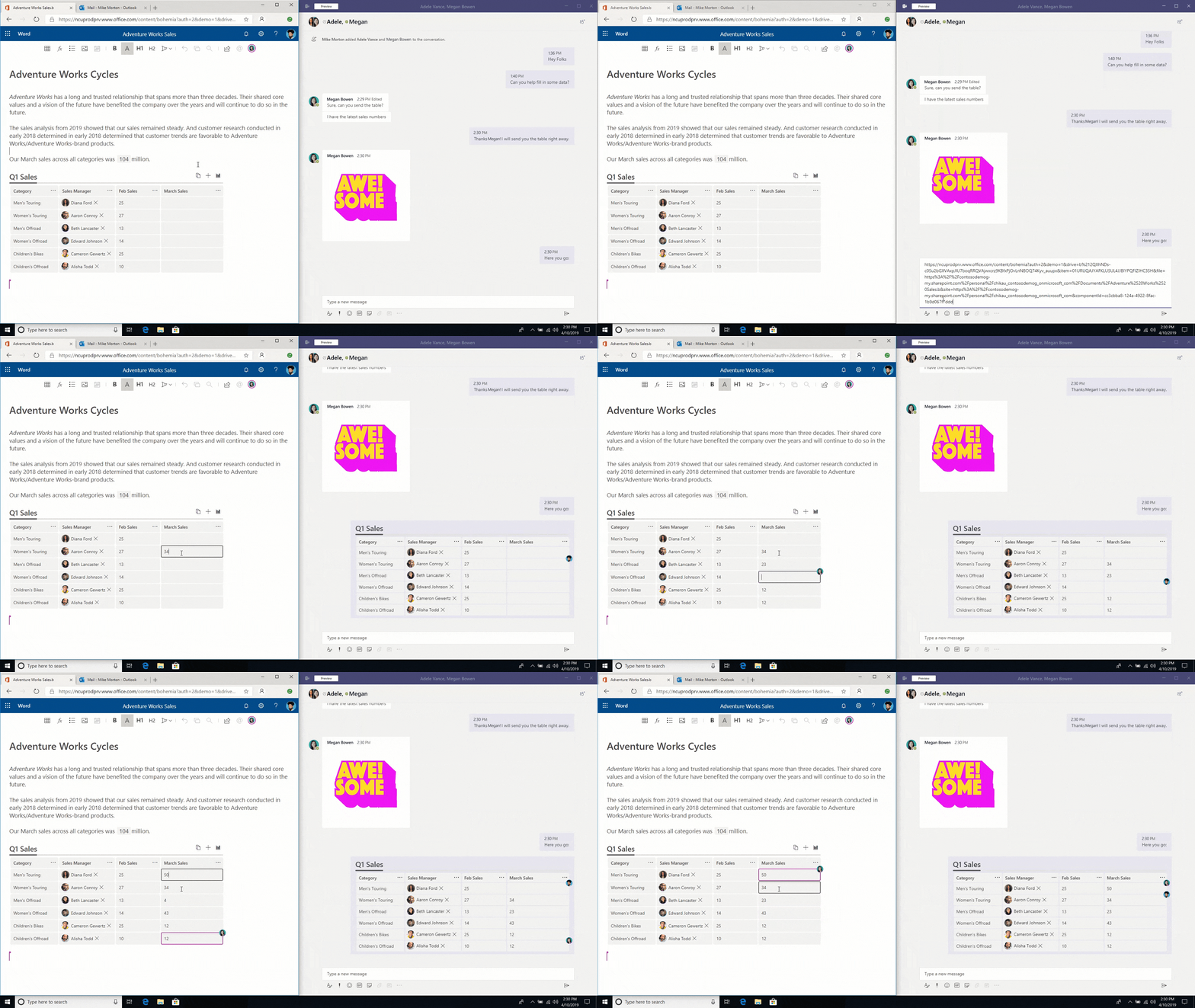
At its core, Fluid is a framework for building collaborative editing experiences, but because it can be integrated across applications, that also means that users will be able to, say, edit a document in an application like Word and then share a table from that document in Microsoft Teams (or even a third-party application like Slack, if Slack decided to integrate this technology). All of the changes sync in real time, of course.

In one of Microsoft’s demos, the company shows how a preview version of Word can’t just handle multiple simultaneous edits, but how users could use formulas to calculate a cell in a spreadsheet inside the text document to calculate a number that is then automatically updated.

In another example, Microsoft shows how developers can create a document that is then automatically translated in real-time to a variety of languages, while still allowing everybody to edit it in their own language.

Collaborative editing isn’t new, of course, but Microsoft promises that the Fluid Framework will sync faster than anything else currently on the market and, what’s maybe more important, give developers the tools to deconstruct and reconstruct documents into different modular components so that they can then be integrated into different applications.

What’s maybe even more interesting is that in a press briefing ahead of today’s announcement, Microsoft PR head honcho Frank X. Shaw described Fluid as a way to “break down the barriers of the traditional document as we know it, and usher in the beginning of the free-flowing canvas.” And indeed, the Fluid Frameworks isn’t just about collaborative editing but it’s really a rethinking of how modern documents should work.

Some startups like Coda, Airtable and more established players like Smartsheet are putting some pressure on Microsoft to rethink its productivity suite by offering modern takes on document editing. That’s something Microsoft has to react to, but it’s also part of the company’s recent push to modernize its applications to better match how employees work today.

Carta was just valued at $1.7 billion by Andreessen Horowitz, in a deal some see as rich

Carta, a seven-year-old, San Francisco-based startup, is the newest unicorn in tech. The company, which helps private and public companies, investors, and employees manage their equity and ownership, tells TechCrunch it has raised $300 million in Series E round at a $1.7 billion valuation, led by Andreessen Horowitz. Firm cofounder Marc Andreessen is also joining the board.

The round has been a poorly kept secret. The outlet The Information reported more than a month ago the details that Carta is sharing today. In fact, that leak has given people in the industry who understand Carta’s business time to quietly ask of its valuation whether it isn’t high for a company that does what it does.

Unsurprisingly, Carta argues that it is not, that it has evolved considerably from the outset — which is true. Though it launched as a way for venture capitalists to more easily manage their equity in private companies, by 2014, Carta, formerly known as eShares, had moved beyond replacing paper records for stock options and shares, and into selling as a monthly service appraisals of the fair market value of private companies’ common stock in order to determine their strike price. It calls this  “409A-as-a-service.”

Carta has continued tacking on more services. Among the most notable was the launch last year of a fund administration product designed to help venture capital firms not only manage their portfolio stakes more easily but to more seamlessly work with their own investors or limited partners. Toward this end, Carta now provides portfolio analytics, including deal IRRs and cash management, it helps VCs distribute their quarterly investor reports, and it integrates with third-party tax and payroll providers.

Carta has so many pieces in place that in a call on Friday, Ward told us Carta is taking what may be its biggest step yet and becoming the first real “private stock market for companies.” Its massive new funding round is “about act three,” he said. “Now that you have this network of companies and investors all on one platform and the ability to transfer securities, you can build liquidity on top of it.” It’s this vision that enticed Andreessen to jump aboard, he suggested.

There’s unquestionably a need for a kind of private stock market. Private funding has been outpacing IPO funding for years, and it shows no sign of stopping. It’s largely why the SEC is trying to better enable people who are not accredited investors to access private company shares. Most of the U.S. has missed out on the wealth creation happening before companies go public or sell to other companies.

It’s also true that Carta has its hooks into meaningful number of startups and venture firms at this point. The company says more than 700,000 shareholders on on its platform, that it works with more than 11,000 companies, and that its fund administration product now serves 143 venture firms.

Still, some longtime industry observers wonder if Carta isn’t mashing together a lot of disparate, moderately lucrative businesses and positioning it as the next-big platform company, and the view resonates. For one thing, Carta likes to talk about assets managed, though it’s really talking about how much in assets the startups and VCs that use its platform control, which is $575 billion altogether. Carta — which now employs nearly 600 employees across seven offices — says its own annual revenue run rate is currently $55 million.

Relatedly, while Ward says Carta’s primary revenue right now is its software subscription business — another revenue stream is the money it’s paid by the venture firms that use it a fund administrator — people who question Carta’s fundraising note the people-intensive nature of the kind of work that Carta has been systemizing. Yes, there’a a sophisticated software component, but Carta is more Accenture than Salesforce, and services businesses are valued very differently.

There’s also the question of growth. Ward points to the roughly 450 startups that are garnering venture funding each month right now — all potential customers for Carta. But plenty of companies are also quietly going out of business all the time, a process that will accelerate whenever this very long funding boom finally slows.

This newest business conveys the impression that big things are coming, though it doesn’t sound exactly like a private stock market as Ward describes it, either. Primarily, it won’t provide the relative transparency that stock markets do. We don’t think that’s the case, anyway. Ward was somewhat dismissive of questions we asked about how Carta’s newest business will be fundamentally different than that of secondary players in the market that are already making it possible for shareholders to value and transact shares.

Indeed, though Carta says it’s changing how assets are acquired, valued, and transacted, Ward also did not respond to several simple follow-up queries sent to him on Friday about the mechanics of this new business, dubbed CartaX. Instead, he thanked us for our efforts to understand and articulate Carta’s business. Meanwhile, his press team told us it was limited in what it can say about how CartaX operates for now.

Carta has savvy investors. In addition to Andreessen Horowitz, this newest round includes Lightspeed Venture Partners Carta, Goldman Sachs Principal Strategic Investments, Tiger Global, Thrive Capital, and earlier backers Tribe Capital, Menlo Ventures, and Meritech Capital.

No doubt that in valuing the company, they took into account that Solium — a Canada-based software-as-a-service for stock administration, financial reporting, and compliance that was publicly traded — sold for $900 million in cash earlier this year to Morgan Stanley. That’s roughly double Carta’s total funding so far of $447 million.

If they were viewing the company based on its potential as a kind of more liquid market, they must also have considered that the parent company of both the NYSE and the Chicago Stock Exchange, has a market cap of $6.28 billion.

Perhaps most important to them, Carta is now as well-positioned as anyone to capture and cater to the growing number of privately held companies looking to provide more of their employees liquidity and to cash out early investors. Add to the mix a mega-round and a star board member, and the company may well get to where Ward and his investors want it to go.

We’ll be watching to see.

Watch Microsoft’s Build 2019 keynotes right here

It’s early May and that means it’s time for all the big developer conferences. After Facebook F8 last week, this week, it’s Microsoft’s and Google’s turn, with Microsoft going first. The company is hosting its annual Build developer conference in Seattle this week, with about 6,000 developers in attendance. As far as we can tell, the event didn’t sell out but Microsoft still expects about 6,000 attendees to be in Seattle.

Likely because Google scheduled its I/O keynotes for tomorrow, when Microsoft would traditionally hold its more technical Day 2 keynotes, Microsoft actually went ahead and announced virtually all of its cloud news at the rather odd time of2pm PT last Thursday (including a minor HoloLens update). This means that today’s festivities will likely focus on the company’s other platforms, including Windows, Office 365, Microsoft 365 and others.

The event will kick off at 8:00am PT/17:00 CET with the finals of Microsoft’s Imagine Cup student competition, which are happening at Build for the very first time. Satya Nadell will then take the stage at 8:30am PT/17:30 CET for his ‘vision keynote.’ This part of the event will likely be less technical and focus more on Microsoft’s overall vision for the future of work. This should last for about an hour and a half.

Later in the morning, at 11am/20:00 CET Microsoft is splitting the keynote into two, with simultaneous technical keynotes by Scott Guthrie and Rajesh Jha.

The company also promises a physical setup for the keynote, which could easily turn out to be a weird gimmick that takes away from the content of the event.

Marshall continues to impress with new retro portable speakers

Marshall, the headphone company and not the loudspeaker company of the same vintage, today announced two new portable speakers. Like the company’s previous offerings, these speaks ooze a retro vibe. The two new speakers, the Stockwell II and Tufton, join the Kilburn II but stand tall, literally and figuratively, apart from the rest of Marshall’s speakers as portable models with a vertical orientation, internal batteries, wireless capabilities, and a rugged casing that should survive a trip outside.

The large Tufton impresses with clear, powerful sound even when on battery. The highs carry over a solid low-end. It’s heavy. This isn’t a speaker you want to take backpacking, but, if you did, the casing has an IPX4 water-resistant rating so it’s tough enough to handle most weather. Marshall says the battery lasts up to six hours.

The smaller Stockwell II is much smaller. The little speaker is about the size of an iPad Mini though as thick as a phonebook. The internal battery is good for four hours and the casing is still tough, though sports an IPX2 rating so it’s not as durable as the Tufton. The speaker is a bit smaller and the music quality is as well. The Stockwell II is a great personal speaker, but it doesn’t produce a pounding sound like the Tufton. Use the Stockwell II for a quiet campfire and the Tufton for a backwood bonfire.

Sadly, these speakers lack Google Assistant or Amazon Alexa integration. Users either have to connect a device through a 3.5mm port or Bluetooth.

I’ve been a fan of every Marshall speaker I’ve tried. For my money, they feature a great balance of sound and classic design. Each one I’ve tried lives up to the Marshall name and these two new speakers are no different. Portability doesn’t come cheap. These speakers cost a bit more than their stationary counterparts. The small Stockwell II retails for $249 while the large Tufton is $399.

Dropbox adds cold storage layer to reduce cost of storing less frequently accessed files

Dropbox started shifting workloads away from AWS to its own data centers several years ago because it needed more control over how files were stored and accessed. It developed a storage architecture called Magic Pocket to help, but over time it recognized that most people moved files to Dropbox for backup purposes, then rarely accessed them again.

Engineers realized it made little sense to have everything stored in the same way when many files weren’t being accessed much after the first day of putting them on the service. The company decided to create two levels of storage, warm storage (previously Magic Pocket) and a new level of longer term storage called Cold Storage, which lets Dropbox store these files less expensively, yet still deliver them in a timely manner should a customer need to see one.

Dropbox customers obviously don’t care about the engineering challenges the company faces with such an approach. They only know that when they click a file, they expect it to open without a significant amount of latency, regardless of how old it is. But Dropbox saw an opportunity to store these files in a separate layer.

“When one is talking about cold storage, we are thinking of files that are accessed less often. And for those files, we can make some trade-offs between storage, performance and network bandwidth,” Preslav Le, a software engineer in charge of the cold storage project told TechCrunch.

So it was up to the engineers to design a system with an acceptable level of latency to retrieve files stored in the cold layer without so much delay that customers would notice. It involved walking a tight design tightrope and considering all of the trade-offs that would be required with such an approach.

“Our cold tier runs on the same hardware and network but saves costs through innovatively reducing disk usage by 25 percent, without compromising durability or availability. The end experience for users is almost indistinguishable between the two tiers,” Dropbox wrote in a blog post announcing the new feature.

The company needed to ensure durability and reliability while creating a new storage layer to reduce their overall costs, and while the project wasn’t easy, they expect the dual tier system to save them 10-15 percent in costs over time.

Grocery startup BigBasket becomes Indian’s newest unicorn with new $150M investment

India has a new unicorn after BigBasket, a startup that deliveries groceries and perishables across the country, raised $150 million for its fight against rivals Walmart’s Flipkart, Amazon and hyperlocal startups Swiggy and Dunzo.

The new financing round — Series F — was led by Mirae Asset-Naver Asia Growth Fund, UK’s CDC Group, and Alibaba, BigBasket said on Monday. The closing of the round has officially helped the seven-year-old startup surpass $1 billion valuation, co-founder Vipul Parekh, who heads marketing and finances for the company, told TechCrunch in an interview. Chinese giant Alibaba, which also led Series E round in BigBasket last year, assumes about 30 percent stake in the company, more than any other investor, a person familiar with the matter said.

The company, which offers over 20,000 products from 1,000 brands in more than two dozen cities, will deploy the fresh capital into expanding its supply-chain network, adding more cold storage centers and distribution centers to serve customers faster, Parekh said. The company also plans to add about 3,000 vending machines that offer daily eatable items such as vegetables, snacks, cold drinks in residential apartments and offices by next month, he added.

Addition of $150 million for BigBasket, which raised $300 million last year, comes as both Walmart’s Flipkart and Amazon are increasingly expanding their grocery businesses in India.

Amazon Retail India, which operates Amazon Pantry and Prime Now services and has a presence in over 100 cities, is reportedly planning to expand its business in India. Flipkart Group CEO Kalyan Krishnamurthy said in an interview with the Economic Times last month that the e-commerce giant may pilot a fresh foods business soon. Last week, Flipkart was said to be in talks to acquire grocery chain Namdhari’s Fresh.

Parekh largely brushed off the challenge his company faces from Flipkart and Amazon at this stage, saying that “it is a very large market, and it is unlikely to be dominated by one single company for the simple reason of its complex nature.” Flipkart and Amazon may eventually get serious about this space, but so far their play with groceries is mostly an additional differentiation checkpoint, he said.

“The success in this business requires having the ability to build and manage a very complex supply chain across multiple categories such as vegetables, meat, beauty products among others. Our focus has been on building the supply chain, and also ensuring that we are able to deliver a very large assortment of products to consumers,” he added. He said BigBasket today offers the largest catalog and fastest delivery among any of its rivals.

Besides, BigBasket, which is increasingly growing its subscription business to supply milk and other daily eatables, is also inching closer to becoming financially stronger. Parekh said BigBasket expects to become operationally profitable in six to eight months. “The idea is that business by itself does not consume cash. If we use cash, it will be for investment in new businesses or scaling of existing businesses,” he said.

India’s retail market, valued at over $900 billion, is increasingly attracting the attention of VC funds. Since 2014, online retailers alone have participated in over 163 financing rounds, clocking over $1.38 billion, analytics firm Tracxn told TechCrunch. More than 882 players are operational in the market, the firm said.

The challenge for BigBasket remains fighting a growing army of businesses, including hyperlocal delivery startups including Grofers, which raised $60 million earlier this year, unicorn Swiggy and Google-backed Dunzo, which is increasingly becoming a verb in urban Indian cities.

Heath coaching app Noom will expand its product team after raising $58M led by Sequoia

Health coaching app developer Noom announced today that it has raised $58 million led by Sequoia Capital.

Other participants include Aglaé Ventures, the tech investment arm of French holding company Groupe Arnault, WhatsApp co-founder and former CEO Jan Koum, DoorDash co-founder and CEO Tony Xu, Oscar Health co-founder Josh Kushner, SB Project co-founder Scooter Braun and returning investor Samsung Ventures.

Headquartered in New York City with offices in Seoul and Tokyo, Noom is best known for its direct-to-consumer weight loss app, but it also develops enterprise products, including an app focused on diabetes and hypertension. Noom’s consumer app competes for users with Under Armour’s MyFitnessPal and Weight Watchers, but its closest rival is probably nutrition and weight loss app Rise because both offer personalized programs and coaching for a subscription fee.

Noom aims to set itself apart by focusing on long-term lifestyle and behavior changes, in addition to calorie, nutrition and exercise tracking. Users get access to 1:1 coaching and fitness programs personalized by an algorithm based on how they answer a questionnaire.

The company will use its new funding to hire more people for product development. In a press statement, Koum said he invested in Noom because it “has many of the same traits that helped WhatsApp disrupt the communications industry. Noom is so far ahead of the competition when it comes to technology, execution and brand recognition that it will be difficult for any company to catch up.”

Sendbird snags additional $50M for messaging API tool, as it extends Series B to $102M

Sendbird, a startup that enables developers to add messaging to their apps with a couple of lines of code, announced a secondary Series B investment of $50 million today. This additional funding comes on top of the $52 million, the company raised in February.

The new money was led by Tiger Global Management with significant participation from the Iconiq, the firm that led the initial Series B round. Today’s investment brings the total raised to over $120 million, according to Crunchbase data.

This is a huge investment for a Series B-level company, and what appears to be driving such a large influx of cash is a fast-growing market with tremendous demand for user-to-user messaging inside apps. By offering this as an API service, developers can drop the capability into their apps without having to build it from scratch. It’s a similar value proposition as Twilio for communications or Stripe for payments.

As SendBird CEO John Kim told us in the first part of the Series B investment in February, his company is aiming to make it simple for developers to add in-app messaging:

“We are a very flexible, fully customizable, white label messaging capability. We come with a fully managed infrastructure. So basically, you can log into any mobile applications or websites out there, and use our messaging capability.”

Kim says today’s additional money comes at a time when his company is accelerating its go-to-market strategy. “Starting from marketing and sales, we are building the go-to-market engine to scale our global presence by hiring leaders in key areas of the business and building teams around those leaders. To accelerate this process, we’re working with our new investors for Series B, who have made many investments in our target markets and built strong connections there,” Kim told TechCrunch.

SendBird was founded in South Korea in 2013. Today, it has 98 employees with headquarters in San Mateo, California. It was a member of the Y Combinator Winter 2016 class.