How tech entrepreneurs think of Universal Basic Income

As tech has grown, policy debates have become an important pastime. Today’s tech industry aspires to replace human drivers with self-driving cars, secretaries with AI assistants, permanent jobs with gigs — and as a result, the human impact of tech has become an everyday conversation.

No other idea is as emblematic of this as Universal Basic Income, a policy that would distribute a monthly sum to every adult regardless of their income or employment status.

The conversation is widespread. Mark Zuckerberg and Elon Musk have said that UBI may be desirable or necessary. Y-Combinator Research and Facebook co-founder Chris Hughes are running basic income studies. Tech-friendly presidential hopefuls Bernie Sanders and Andrew Yang support the issue.

But should the average tech entrepreneur or investor support UBI? The answer is not entirely clear.

The good news is that the tech industry is deeply familiar with risk, which is an important component of arguments for UBI. The bad news: risk isn’t the whole story, and both positive and negative evidence for the policy are currently thin.

Image via H. Armstrong Roberts/ClassicStock/Getty Images

The role of risk

Entrepreneurs understand the risk component of UBI because it’s the same risk they take in starting companies. Many entrepreneurs start with savings or seed funding that reduce their downside risk — and it’s not hard for them to imagine that others lack these resources. A UBI could solve the issue.

“The hypothesis is, [UBI will] fundamentally change people’s lives. They’ll do something different from what they were doing, because they have a continuous stream of basic income they can depend on. They can start small firms, invest in assets that give them better incomes and wealth, and that translates into better health and education for their kids,” summarizes Tavneet Suri, an applied economics professor at MIT who is helping GiveDirectly run a UBI program providing about 75 cents per day to recipients in rural Kenya.

Risk is clearly important in the developing world, but it’s also an increasingly urgent story in the US. Rates of new business formation have, in recent years, fallen below business closings. There’s a correlation between low entrepreneurship and low savings rates: 40 percent of American adults say they can’t cover a $400 emergency expense, according to the Federal Reserve. Starting businesses may simply be too risky for this generation.

In fact, a newly insecure class is already growing in developed countries worldwide. Guy Standing, a professorial research associate at the University of London, calls this class the precariat. “What is distinctive about global capitalism today, and this will continue, is that even many of those currently earning enough to put them into middle-income categories feel insecure, and often live on the edge of unsustainable debt,” Standing wrote to TechCrunch. “What is significant for those interested in promoting entrepreneurial risk-taking is that one can show that the emancipatory value of a basic income is greater than its monetary value, which is the opposite to all other forms of social policy.”

The universality of risk in both rich and poor countries is a positive for UBI proponents, since studies like Suri’s are taking place in the developing world. An argument can easily be made that behaviors like immigrating to a city or going to college may be riskier in developing countries, but also carry risks in the rich world, which aren’t necessarily offset by financial instruments like loans. “I would never have done my Ph.D. if I’d had to pay for it. There’s no probability in any world. I wouldn’t have wanted to take the loans, because what if I don’t get a job?” says Suri.

However, it will take years to answer the question of how UBI interplays with risk. Suri’s study, for instance, includes cohorts who receive an up-front lump sum, a 2-year monthly UBI payout, and a 12-year payout — so the full effects won’t be visible for some time.

Image via Getty Images / iNueng

The effects on workers

Estimating the effects of a UBI on entrepreneurship, immigration or higher education offer clear arguments for risk. But when it’s extended to people who are currently employed and have no obvious need or desire to start their own company, the picture becomes more muddled.

Some hypothesize that a UBI could lead to workers quitting jobs, or the unemployed choosing to stay that way. Wesley Pech, a behavioral economist at Wofford College, frames these possibilities as a tension between two theories of consumer behavior. The income effect and substitution effect respectively predict that people given basic incomes would choose unemployment or choose to continue seeking work. No basic income study has definitively shown that either outweighs the other. “I can’t think of an experiment so well designed that it could serve as a benchmark,” says Pech.

So here, too, UBI needs more study. But for the time being, anecdotal reports praise basic income.

In Germany, which is generally regarded as fairly wealthy and egalitarian, a startup called Mein Grundeinkommen is using crowdfunding to supply a €1,000 monthly income to 316 people, and currently adds about 15 more people each month. Founder Michael Bohmeyer says universality is an important psychological component of basic income.

“When you frame basic income as a poverty distinction instrument, then it feels like welfare money. You’re the one who didn’t make it, the stupid one, and now you get money to fix it,” he told TechCrunch. “Basic income is something else, it’s for everyone and free of conditions.” That leads to different results than welfare. For instance, one older man on welfare — an identical amount to the Mein Grundeinkommen basic income — decided to end his own unemployment by starting an online business after receiving his basic income from Mein Grundeinkommen.

The psychological effects can be huge even for the well-off. “Surprisingly, we’ve found out that the people who thought that they wouldn’t really need it, they had the biggest effects and changes in their lives,” says Bohmeyer.

Image via Getty Images / Mongkol Chuewong

Another of Mein Grundeinkommen’s basic income recipients was unhappy with her family inheritance, a hotel she was expected to run. After starting to receive her stipend, she had the mental space needed to work through her issues, and took the steps necessary to become a good business owner.

“We have a strong idea that when basic income is introduced, people will stop working. This is even what people think before receiving the money. They think, I’ll start a business, I’ll quit my job, and we have a lot of women who say, I’ll quit my marriage to my stupid husband because I’m not dependent on him anymore. All of a sudden, the basic income comes, and you have more possibilities. You’re free to go. Once you can say no, it’s different to say yes,” says Bohmeyer.

These stories reveal a side of UBI that goes beyond risk and basic human behavior: it can also be framed as an argument for basic human dignity, and a world that exists for more than just work. “The people with basic incomes seemed to not be so ego focused anymore, they had an empathetic, wider approach to look at the world,” says Bohmeyer.

“It sounds so silly when I say it, but that’s what I realized. I think we need to find more about this because we have tremendous changes in our society. It’s the ending of the industrial age and beginning of the digital age, and I think this is what we need in our society.”

At the end of the day, though, Mein Grundeinkommen’s stories remain anecdotal, and thus flawed, just like past basic income studies. Bohmeyer is aware of the problem: Mein Grundeinkommen will join the ranks of more rigorous projects by the end of this year, as it works with the German government to begin a multi-year study giving €1,200 monthly to on 100 participants.

And that’s the best policy that anyone in tech can take: wait, watch, and if possible, contribute support to the studies taking place around the world. UBI is too complicated an issue for partisan stands or knee-jerk reactions. And in the future that the tech industry expects and hopes for, it may yet prove to be one of the best policy ideas available.

Report: Sinclair to buy Disney’s 21 regional sports networks for $10B

TV broadcasting company Sinclair will buy 21st Century Fox’s 21 regional sports networks from Disney for $10 billion, according to a report from The Wall Street Journal. Sinclair was one of several bidding for the sports networks, which had also seen interest from Liberty Media, MLB, and Big 3 Basketball LLC. Sinclair had come out on top thanks to its mostly-cash deal, according to a report last week from Fox Business crediting unknown sources.

The earlier report had also pegged the deal price of $10 billion.

Disney had come to own the regional sports networks by way of its $71.3 billion purchase of Fox, which closed in March. That acquisition gave it more movies, TV and IP including film titles like “The Shape of Water,” “Avatar,” and “Deadpool,” TV shows like “The Simpsons” and “Atlanta,” and majority ownership of Hulu.

The company agreed to sell off the sports networks in order to win government approval for the Fox deal.

Separate from the new deal with Sinclair, Disney sold off the YES Network, the most prominent of the 22 regional sports networks it was looking to unload. The buying group, which included the New York Yankees, Amazon, as well as Sinclair, had agreed to pay $3.5 billion for the network, according to other media reports.

The WSJ confirmed this as well, noting the deal hadn’t been finalized.

The new agreement with Sinclair will see it acquiring other major sports networks, including channels in L.A. and Detroit.

The deal is expected to be announced today.

Google’s budget Pixel 3a XL pops up at an Ohio Best Buy

The Pixel 3a is arriving next week at Google I/O. That statement felt like all but a given before, and now that’s the handset is showing up at Ohio-area Best Buys, well, you can pretty much bank on it at this point.

Google’s budget take on its Pixel flagship is expected to take the stage during the May 7 keynote at Mountain View. Meantime, we’ve got another pretty good look at the thing courtesy of an Android Police reader who spotted boxes at a Springfield store.

The shots confirm Google’s strict adherence to silly color naming conventions, with the appearance of “Purple-ish” alongside “Just Black.” The former is a new color and looks to be about as subtle as you can get with a purple piece of electronics. Other side-of-the-box specs confirm what we’ve seen so far, including a 6-inch display on the XL version, coupled with 64GB of storage.

The handsets arrive just six or so months after the release of the Pixel 3. The company addressed the flagship device’s poor sales on this week’s earnings call, noting, among other things, that it had some hardware planned for I/O, marking a break from past years. It will be interesting to see how Google positions the product, as it continues to make software, AI and ML the focus of upgrades over hardware specs.

More info on what to expect next week in Mountain View can be found here.

Tesla bumps its capital raise up by $400 million, with Elon Musk taking an additional $15 million

Tesla is going to raise an additional $400 million in its latest sale of stock, with co-founder and chief executive Elon Musk committing to buy an additional $15 million in shares, according to a filing with the Securities and Exchange Commission.

The electric vehicle, energy storage and solar panel manufacturer said it will sell 3.1 million shares at $243 per share. The underwriters are jointly underwritten by Goldman Sachs and Citigroup . At the same time, the company said it would boost its convertible note offering by another $100 million.

Initially Tesla was going to sell $2.3 billion in stock and warrants, but the new totals boost that number to $2.7 billion, with Elon Musk upping the ante of his own purchase as part of the revised deal.

The company said that Musk would boost his purchase from $10 million to $25 million as part of the sale of stock.

News of the increased share sale, revised just one day after Tesla announced that it would turn to capital markets to raise more cash, comes despite its report of a rocky first quarter, just one week ago.

Zachary Kirkhorn even called it “one of the most complicated quarters” in Tesla’s history.

Tesla lost $702 million in the first quarter of the year, but its challenges and cash constraints haven’t dimmed investor appetite for shares in the stock.


CBS says streaming services & Super Bowl helped it achieve record revenues in Q1

CBS credited its direct-to-consumer streaming services in helping it achieve double-digit revenue growth and  record quarterly revenues in Q1, along with the gains that came from hosting Super Bowl LIII and those from affiliate revenue. The network said its over-the-top service for cord cutters, CBS All Access, combined with Showtime’s direct-consumer subscriptions grew 71 percent year-over-year — its biggest quarter of growth ever.

Both services are continuing to grow in Q2, as well, thanks to The Twilight Zone on CBS All Access and Billions on Showtime, the company noted.

In addition, CBS is benefitting from other streamers’ needs for content. It spoke of gains from increasing sales of its content to providers like Amazon, Apple, and Netflix, for example. The latter has just debuted Dead to Me from CBS Television Studios, on its service. And CBS is producing Diary of a Female President for the Disney+ streaming service, which begins filming this summer.

The market’s appetite for over-the-top streaming TV services has helped CBS succeed in the cord cutting era, thanks to its investment in streaming platforms and original content for subscribers, like The Twilight Zone, The Good Fight, Star Trek: Discovery, and other shows.

However, the Super Bowl played a huge role in boosting subscriptions this quarter — the company even noted that CBS All Access had its “biggest quarter of [subscriber] growth ever.”

But CBS may be able to retain subscribers who joined for the Big Game with its other original programming, like The Twilight Zone which was the most-watched original premier, for instance.

It also touted upcoming new originals, including a dark comedy starring Lucy Liu called Why Women Kill from Desperate Housewives’ creator Mark Cherry; a true crime drama called Interrogation; and a brand-new Star Trek series starring Patrick Stewart.

CBS said it’s now working to take CBS All Access to more international customers. Having already launched in Canada and Australia, it’s coming next to Latin America and Western Europe.

In February, CBS said it had reached its goal of 8 million streaming subscribers two years early — a figure which included Showtime’s direct-to-consumer subscribers, as well. It said it was aiming to reach 25 million domestic subscribers by 2022, up from its early plan to reach 16 million by that time.

Earlier this week, Hulu announced it had topped 28 million customers, for comparison’s sake.

CBS didn’t update those numbers, but said the company still feels “very good” about achieving them.

What CBS can’t project, though, is how its growth may be impacted by the arrival of the other new streaming services coming to market in the months ahead, including Apple TV+, Disney+, the WarnerMedia streaming service, and perhaps even Jeffrey Katzenberg’s mobile streaming service Quibi. As all will rely on subscriptions, consumers may end up having to pick-and-choose which ones to pay for — as few can afford to subscribe to all.

It did say that it believes Apple TV+ will help it to grow, however, because it will help distribute CBS content to more customers, and boost its own subscriptions as a result.

“Given our company’s strong programming pipeline and our early-mover advantage in direct-to-consumer, we feel very confident about CBS’ leadership position in a media landscape that values must-have content above all else,” noted Joe Ianniello, CBS President and Acting CEO, in a statement. 

CBS reported earnings of $1.37 per share in Q1 on $4.2 billion in revenue. It was projected to earn $1.36 per share on $4.3 billion.

Sustainability-focused Ecosystem Integrity Fund closes on $100 million

With six deals already under its belt, the sustainability focused investment firm Ecosystem Integrity Fund has closed its third investment vehicle at its $100 million target.

Investments in the third fund include EV Connect, an electric charging company; eMotorWerks, the charging demand management software and service provider acquired by Enel; solar mounting company, Pegasus Solar; the water management company, Opti; and Flying Embers, a probiotic adult beverage company.

Investing in disparate sectors like consumer-focused wellness and organic brands and utility-focused software and services may seem like strange portfolio bedfellows, but the portfolio addresses a key issue for early-stage investment firms, which is following where money gets spent.

The San Francisco-based firm, led by managing partners James Everett and Devin Whatley, with partners Geoff Eisenberg and Sasha Brown, formed after the managing partners left their roles at the boutique investment bank Aquillian. 

EIF launched its first fund in 2011 with $19.6 million under management and returned 1.84 times the capital invested in the fund with a 34.4% net internal rate of return to limited partners. Its second fund raised $57 million and backed six portfolio companies.

“We seek to invest in areas that have not received sufficient investor attention,” said James Everett, managing partner, Ecosystem Integrity Fund, in a statement. “The movement toward environmental sustainability is making incremental improvements to the largest industries in the world. Sustainability is fundamentally about making things better: more efficient, more functional, less toxic, less costly.”

Overall, sustainability focused investments or investments in clean technology are gaining ground again after years of languishing. Last year, global venture capital and private equity investment jumped 127% to $9.2 billion, the highest since 2010.

And some of the biggest opportunities exist in an investment category that was largely unexplored by the first wave of clean tech investors. In the years since clean technology’s initial boom in the mid-2000s, investments focused on health and wellness and sustainable food production have surged.

Recent examples include the blockbuster public offering for Beyond Meat and that trend is even reflected in the largest dollar value exit for EIF, an over $200 million sale of the beverage maker Kevita to Pepsico.

“What we can do is change consumer preferences,” says Eisenberg. “We can get people to stop eating things that have unsustainable ingredients.”

Sonic the Hedgehog director says character is getting makeover after backlash

In 2006, New Line Cinema added five days of reshoots for Snakes on a Plane, six months after principal filming had wrapped. The new shoots helped change the films rating from PG-13 to R, courtesy of, among other things, the addition of the line “I have had it with these motherf****** snakes on this motherf****** plane!”

It was an early and still one of the best known instances of a film being altered in post-production over internet consensus. While the forthcoming Sonic the Hedgehog is likely still gunning for a family friendly rating, online outrage is apparently causing the fleet-footed video game hero to get a makeover.

Of course, the bizarre CGI take on the 90s character was one of dozens of glaring issues with the two and a half minute trailer, but it may well be the easiest to address without extensive reshoots. Certainly social media had no shortage of suggestions for how Sega and couple could firmly remove Sonic’s feet from the furcanny valley — and hey, what’s a little post-production on top of a $90 minute budget?

Jeff Fowler, who is making this feature film directorial debut with Sonic, took to Twitter to address the issue, noting, “Thank you for the support. And the criticism. The message is loud and clear… you aren’t happy with the design & you want changes. It’s going to happen.”

https://platform.twitter.com/widgets.js

Paramount has yet to offer an official statement on the matter, including whether such a move might impact release date. On the upside, there’s still some time, with the film not scheduled to arrive until November. And besides, the internet had plenty of suggestion on how Sonic could be improved. It always does.

https://platform.twitter.com/widgets.js

The old adage among online writers is “never read the comments.” It’s a bit of self-self-preservation of one’s own sanity. And certainly it’s possible to be too response to an online fanbase when create a work of art, or whatever Sonic purports to be. But in the case of a decades-late film adaptation of a video, honestly, it might be for the best.

New a16z funds, a $200M round, and the latest from WeWork and Slack

Hello and welcome back to Equity, TechCrunch’s venture capital-focused podcast, where we unpack the numbers behind the headlines.

This week brought the ever-excellent Danny Crichton back to the show, along with myself. The two of us opted to do a bit of a news run, so strap in for a host of topics. Of course, we had to cover some IPO news at the end, but here’s what else happened this week that caught our eye:

  • New funds at a16z! We haven’t chatted about new funds too much this year, but a16z’s two new funds ($750 million and $2 billion) are a big deal. The bio and crypto and early-stage firm now has a separate late-stage vehicle.
  • More Vision Fund! SoftBank’s capital cannon is going to double up its crew and possibly reload with $100 billion more. Maybe. The personnel thing is happening, according to the firm. The money, more like probably.
  • Cheddar exits! It’s always nice when a media company works out, and Cheddar’s up-exit at $200 million is a win. Sure, it’s no Slack but the scrappy video network ran hard and managed to cross the line worth nine-figures. Not bad.
  • Divvy snags $200 million! This week Divvy raised as much in one go as Cheddar sold for, a good reminder of how rich the venture market is today. Divvy has been on a fundraising tear in the last 18 months, landing a Seed, Series A, Series B, Series C, and a debt round since December 2017.

And then we pivoted to the two topics we had no choice but to talk about: The WeWork IPO news (more here), along with the latest on Slack’s S-1 from Danny himself.

All that and we had some fun. Chat you all next week.

Equity drops every Friday at 6:00 am PT, so subscribe to us on Apple PodcastsOvercast, Pocket Casts, Downcast and all the casts.

Capital.com powers Currency.com’s ‘world first’ in tokenising government bonds

With the SEC recently releasing its long-awaited guidance on Crypto token issuers, it’s becoming clear that the crypto world is edging closer to the traditional financial world. New players are joining the sector who hail from traditional finance and trading backgrounds.

Until this year, crypto exchanges focused on providing access to ICOs instead of providing access to traditional capital markets with real value and revenues.

When Currency.com launched its beta in January among influencers in the finance, trading and crypto space, it looked to address this deficit. The company says it attracted 150,000 people to the waiting list to test the platform and have since onboarded around 5,000 so far. Now the platform aims to take a further step.

Today it’s launching what it claims to be the world’s first tokenized government bond. This could be construed as a significant move, but it will come down to whether the market welcomes this or not.

Currency.com’s full launch will make 1,000 tokenized securities available to both private and institutional investors globally but will exclude the USA and those on the FATF list.

The underlying tech story here is that Currency.com leverages the technology of Capital.com, its sister platform regulated by the FCA and CySEC.

Capital.com is a fintech startup with an AI-enabled trading platform available on the web and on mobile, which works to works to detect clients’ trading biases and recommends personalized content to help them trade smarter. The startup is backed to the tune of $25M by VP Capital, the vehicle of London-based investor Viktor Prokopenya and Larnabel Ventures.

Currency.com will enable users to trade and invest in tokenized government bonds using fiat money, Bitcoin or Ethereum and has issued a tokenized version of Belarusian government bonds and plans to include additional tokenized government and corporate bonds over time.

So, if you want to trade in Belarusian government bonds, this is the place for you.

However, there could be enormous regulatory hurdles ahead for something like this, internationally, and bond issuers may well look askance at such a project.

But for now, Ivan Gowan (pictured), Currency.com’s CEO who previous to this led IG Group’s IT function for over 15 years, says he is confident the move will be a big one.

“The arrival of tokenized securities will completely change how investors can use their cryptocurrencies. Linking crypto to the price of stocks and shares provides a tangible way for holders of Bitcoin and Ethereum to access traditional financial markets. Our beta launch proved the appetite is there globally for a service like this and Currency.com’s full launch marks a significant shift in the direction of crypto as it becomes more regulated and starts to move closer towards traditional markets,” he said.

Traditionally, government bonds offer the most secure assets alongside cash – however, they provide a better interest rate.

However, the Bonds market and securities that can be tokenized is a market measured in trillions as opposed to billions, because the bond market is a much larger market than that for equities and is harder for retail customers to access.

Furthermore, the risk-adjusted returns and risk of default are totally different to ICOs.

Tokenizing bonds, therefore, could allow retail clients access to a less volatile market to help them grow their wealth without the ups and downs experienced by the normal equities market.

That, at least, is the theory.

What is in favor of Currency.com’s move is the fact that the LSE, NASDAQ and the Swiss Stock Exchange are all looking to move into tokenized securities.

If Currency.com steals a march on them, all well and good. If government bond issues take umbrage, however,… not so good.

Currency.com may at least benefit from its well-built mobile app allowing crypto investors to trade more easily on mobile, featuring Stops, limits and negative balance protection.

Now, while the platform will be regulated, it must be pointed out that the regulation isn’t coming from a traditional jurisdiction. Currency.com will be regulated by the High Tech Park in Minsk, Belarus.

This claims to be “one of the strictest set of regulations in the world” and covering “strict AML, KYC processes.”

Last year Belarus introduced “Decree 8” which boosted the countries laws around the tech sector and crypto.

So, in theory, the wind is at the back of such a launch, given a favorable regulator and government.

Time will tell whether this move will ultimately be a win for Capital.com, the underlying tech company behind this whole enterprise.

Asto, the bookkeeping app from Santander, adds invoice financing for freelancers and SMEs

Asto, the Santander owned “upstart” developing financial tools for freelancers and SMEs, is adding invoice financing to its bookkeeping app.

The new offering, which potentially opens up so-called “micro-financing” to a much broader business market, comes hot on the heels of Santander Group acquiring Albert, an invoicing and expenses app for freelancers and micro-businesses. Albert’s functionality has now been integrated into Asto, with Albert co-founder Ivo Weevers becoming Asto’s Chief Product and Design Officer.

In a call, Weevers described Asto’s mission as wanting to create a “full-stack of financial services for self-employed people [and other micro businesses]. Financial services for SMEs is a “huge, fast-growing market,” he says, adding that Asto is innovating on the bookkeeping side, [while] other players on the market are working on the bank account side”.

“A lot of people are struggling with trying to understand and get access to finances that might help them in growing their business or overcoming certain periods of their business where extra cash would be really handy,” he tells me.

“What we’re doing now is providing a comprehensive solution where we help people with their daily tasks around bookkeeping and understanding where they are financially, but also connecting dots seamlessly with a financial solution. This is what this new micro-financing solution is all about”.

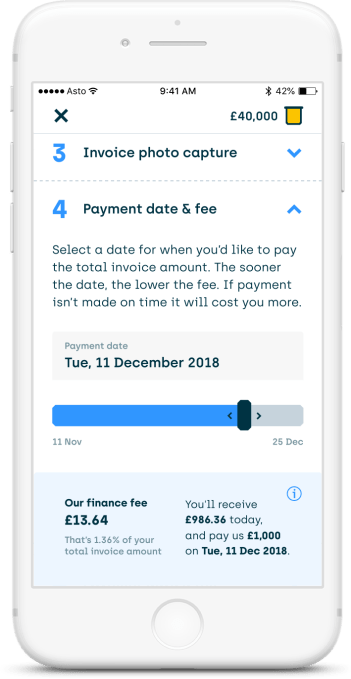
In a demo I’m given of the new invoice financing feature, it all feels relatively painless. After signing up to Asto and applying for the micro-finance option, you’re given an estimated pot of credit from which to drawn down on per invoice financed.

Invoices can be issued simply within the mobile app (or uploaded to it), which in itself is quite a time saver. Anyone who freelances knows that writing invoices and tracking them is a pain. Even more so is waiting to be paid.

Next to each invoice is a finance button. Clicking on it initiates the micro loan, with clear signposting on how much you’ll need to pay back and when. The timeframe is based on the payment terms of your issued invoice with a bit of extra leeway if needed.

“Micro-financing used to be accessible only for the larger SMEs, people with financial knowledge and have the time to go into a branch and talk to an account manager and wait for a few weeks to get a decision,” explains Weevers.

“One of the innovate steps we are trying to do here is we are making this option available for the smaller end of the SME market, which is by far the biggest and by far the most unserved. By doing it on mobile, which is their favourite device, and also doing it in a matter of minutes rather than having to wait for weeks,” he adds.

Meanwhile, I’m told that the credit itself is provided by Asto via owner Santander. Noteworthy, the invoice financing feature doesn’t for the time being use transaction data pulled in from bank accounts you have linked to the app. Instead, Asto is using a range of other data points and info you provide when first applying for the micro-financing option.