From launch to launch: Peter Beck on building an orbital business from scratch

Breaking into the launch industry is no easy task, but New Zealand’s Rocket Lab has done it without missing a step. The company has just completed its third commercial launch of 2019, and is planning to increase the frequency of its launches until there’s one a week. It’s ambitious, but few things in spaceflight aren’t.

Although it has risen to prominence over the last two years at a remarkable rate, the appearance of Rocket Lab in the launch market isn’t exactly sudden. One does not engineer and test an orbital launch system in a day.

The New Zealand-based company was founded in 2006, and for years pursued smaller projects while putting together the Rutherford rocket engine, which would eventually power its Electron launch vehicle.

Far from the ambitions of the likes of SpaceX and Blue Origin, which covet heavy-launch capabilities to compete with ULA to bring payloads beyond Earth orbit, Rocket Lab and its Electron LV have been laser-focused on frequent and reliable access to orbit.

Utilizing 3D printed engine components that can be turned out in a single day rather than weeks, and other manufacturing efficiencies, the company has gone from producing a rocket a year to one a month, with the goal of one a week, to match or exceed its launch cadence.

Seem excessive? The years-long backlog of projects waiting to go to orbit disagrees. There’s demand to spare and the market is only growing.

Peter Beck, the company’s founder and CEO, sat down with us to talk about the process of building a launch provider from scratch, and where the company goes from here — other than up.

Devin: To start with, why don’t we talk about the recent launches? Congratulations on everything going well, by the way. Any thoughts on these most recent ones?

Peter: Thanks, it’s great to be hitting our stride. We wanted electron to be an accurate vehicle and we’re averaging within around 1.4 kilometers. When you get into what that means, at those speeds it takes 180 milliseconds to travel 1.4 km, so we’ve got the accuracy down pat.

Daily Crunch: Indiegogo has a new CEO

The Daily Crunch is TechCrunch’s roundup of our biggest and most important stories. If you’d like to get this delivered to your inbox every day at around 9am Pacific, you can subscribe here.

1. Indiegogo hires Reddit’s Andy Yang as new CEO

CEO David Mandelbrot is stepping down, and according to sources close to the company, several other Indiegogo employees are also leaving.

Mandelbrot announced his departure on LinkedIn, citing “personal reasons.” He was at Indiegogo for six years, starting as senior vice president of operations in August of 2013. Yang, meanwhile, recently led the product team at Reddit.

2. Google’s Duplex calls still frequently require human intervention

Google’s AI-based reservation booking service seems almost too impressive to be a machine. And in fact, now that it’s being used for real-world reservations, the company revealed the calls are often made by human operators at call centers.

3. Invites are out for Apple’s June 3 WWDC keynote — there will be unicorns

On the books for this year’s event: iOS 13, watchOS 6, macOS 10.15 and maybe Apple TV.

4. Leak reveals Uber’s $9.99 unlimited delivery Eats Pass

The subscription would waive Uber’s service fee, which is typically 15% of your order cost.

5. Rotten Tomatoes will start verifying ticket purchases for audience reviews

To be clear, you’ll still be able to leave a review without verification, but verified reviews will be clearly marked, and only those reviews will be included when calculating the Audience Score.

6. Panic’s Playdate is a pint-sized gaming machine with a ‘season’ of 12 intriguing titles

Panic, renowned creator of useful Mac apps and more recently publisher of interesting games, has created a tiny handheld console that goes anywhere and receives a regular trickle of new games. It’s called Playdate.

7. 10 immigration tips for love-struck tech workers

There’s nothing more romantic than a carefully prepared green card application. (Extra Crunch membership required.)

Indian PM Narendra Modi’s reelection spells more frustration for US tech giants

Amazon and Walmart’s problems in India look set to continue after Narendra Modi, the biggest force to embrace the country’s politics in decades, led his Hindu nationalist Bharatiya Janata Party to a historic landslide re-election on Thursday, reaffirming his popularity in the eyes of world’s largest democracy.

The re-election, which gives Modi’s government another five years in power, will in many ways chart the path of India’s burgeoning startup ecosystem, and the local play of Silicon Valley companies that have grown increasingly wary of recent policy changes.

At stake is also the future of India’s internet, the second largest in the world. With more than 550 million internet users in India, the nation has emerged as one of the last great growth markets for Silicon Valley companies. Google, Facebook, and Amazon count India as one of their largest and fastest growing markets. And until late 2016, they enjoyed great dynamics with the Indian government.

But in recent years, New Delhi has ordered more internet shutdowns than ever before; and puzzled many over crackdowns on sometimes legitimate websites. To top that, the government recently proposed a law that would require any intermediary — telecom operators, messaging apps, and social media services among others — with more than 5 million users to introduce a number of changes to how they operate in the nation. More on this shortly.

Growing tension

Amazon is reportedly working on an emotion-tracking Alexa wearable

Amazon probably knows everything else about you at this point, so why not let it track your emotions, too? The company is said to be working on a wearable wellness device said to be able able to determine a user’s emotional state. Word arrives from a Bloomberg story based on “internal documents.”

This comes on the heels of a patent issued for the company designed to let Alexa determine a speaker’s mood and respond accordingly based on how they’re feeling. That filing highlighted relevant emotions like “happiness, joy, anger, sorrow, sadness, fear, disgust, boredom [and] stress.” That’s a pretty wide range of reactions for a smart assistant.

The smartphone-connected, wrist-worn device is said to be the product of the Alexa and Lab126 hardware team. It’s currently being tested, internally, under the codename “Dylan.” It’s worth noting that Amazon has recently been encouraging a lot of experimentation among its internal hardware team, especially when it comes to Alexa products. Among other things, that experimentation has led to the creation of Echo Buttons. Most, however, haven’t made it past the trial phase.

Amazon’s tight lipped on the matter, and the anonymous folks who’ve been discussing the device haven’t offered any info on potential timeframe. All we do know for sure is that Amazon’s looking to get Alexa on as diverse and array of products as possible, and this certainly qualifies as that.

Here’s the first teaser trailer for the new Star Trek: Picard series

Just a bit shy of a year ago, Patrick Stewart blew the minds of Star Trek fans everywhere by taking the stage at the Las Vegas Star Trek convention to announce he was returning to the role of Jean-Luc Picard.

His return would come in the form of a series made for CBS’ streaming service, CBS All Access. He hinted that Jean-Luc may no longer be the captain we know from years ago — but beyond that, details were light.

The first teaser trailer for the series just dropped… and sure enough, it sounds like he’s not a part of Starfleet at all anymore.

“Tell us… why did you leave Starfleet, Admiral?”, says a voice in the trailer, the camera panning over a case of “Chateau Picard” wine. In Trek lore, the Picard family has a winery in France; the trailer implies that post-Starfleet, Jean-Luc has retired to the family vineyard.

This series is said to take place roughly 18 years after Patrick Stewart’s last Star Trek film, Nemesis — or, as some fans have already worked out, the year 2397. The trailer speaks of an “unimaginable” event that happens in the years shortly after Nemesis, perhaps shaking Jean-Luc enough to retire once and for all. (Also worth noting that the voice refers to him as “Admiral” rather than “Captain”, suggesting that Picard finally took the promotion at some point post-Nemesis.)

What happened? And why is Jean Luc seemingly returning now? We’ll find out in just a few months; the series is scheduled to arrive “at the end of the year” 2019

Automattic acquires subscription payment company Prospress

Automattic, the company behind WordPress.com, WooCommerce, Longreads, Simplenote and a bunch of other cool things, is acquiring a small startup called Prospress. Among other things, Prospress has developed WooCommerce Subscriptions, a recurring payment solution specifically designed for WooCommerce.

Given that physical and digital subscriptions are taking over the e-commerce world, it makes sense that Automattic wants to own WooCommerce Subscriptions. Charging customers on a regular basis is one of the most painful challenges when it comes to payment.

Prospress also works on a marketing automation tool to remind customers that they have abandoned their carts, follow up, cross sell and more. The company also has a tool to test your checkout functionality before going live. After the acquisition, the Prospress team will keep iterating on its own products and join the rest of the WooCommerce team.

This is a strategic acquisition more than anything else. Prospress has around 20 employees, so it’s not going to change the face of Automattic and its team of 900 people. But it’s an important move so that Automattic can own a bigger chunk of the (e-commerce) stack.

WooCommerce competitor Shopify doesn’t provide subscriptions out of the box. You have to use third-party products, such as Bold or ReCharge.

Like WordPress, WooCommerce is an open source project — it integrates directly with WordPress. It means that anyone can download WooCommerce and host it on their servers. And the WooCommerce ecosystem is one of the main advantages of WooCommerce compared to obscure e-commerce solutions.

Many WooCommerce users probably host their e-commerce website on WordPress.com. But by controlling the payment module, Automattic can also generate some revenue if WooCommerce users choose to use WooCommerce Subscriptions as their payment solution.

Zero raises $20 million from NEA and others for a credit card that works like debit

Just ahead of the launch of the Apple Card, a startup that has its own take on modernizing the credit card industry, Zero, is announcing the close of its $20 million Series A. The new round of funding was led by New Enterprise Associates (NEA), and brings Zero’s total raised to date to $35 million, including both equity and debt funding.

Other investors in the round include SignalFire, Eniac Ventures, Nyca Partners, and some unnamed school endowments. Zero had previously announced an $8.5 million raise in fall 2017, led by Eniac, and had raised $7 million in venture debt from Silicon Valley Bank.

Zero has a clever idea that targets millennials’ hesitance to sign up for credit cards.

Today, only 33 percent of millennials have a major credit card, a Bankrate survey found — largely because they’re wary of falling into the vicious debt cycle. Instead, this younger demographic often only carries a debit card. But that also means they’re missing out on credit card benefits — like points, rewards, and cash back.

Zero’s idea is to offer a rewards credit card that works like debit.

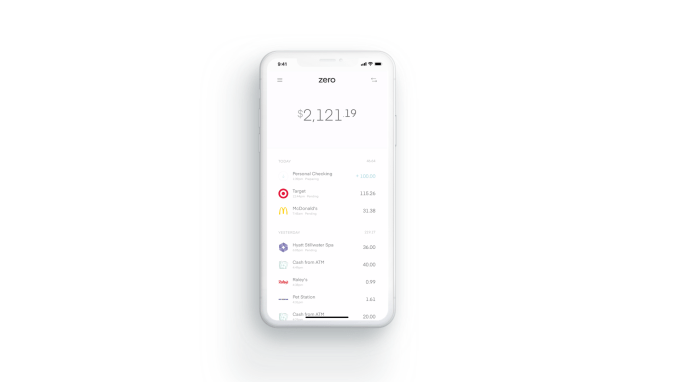
The Zerocard itself is a World Mastercard, so it earns credit card cash back. But unlike a traditional credit card, it’s combined with an FDIC-backed checking account called Zero Checking. That means Zerocard and Zero Checking work together in the app, allowing cardholders to see one net number they can spend from.

That way, they won’t make the mistake of accidentally going over budget, as is often the case with traditional credit cards who then benefit from charging interest on the unpaid balance.

Zero co-founder and CEO Bryce Galen says he had always liked optimizing his personal finances, but didn’t see the value in overspending to chase rewards.

“People spend 10 to 15 percent more on average just because they’re putting it on a credit card, and not seeing where they stand all the time,” he says. “Spending 10 to 15 percent more to chase 1 to 2 percent in rewards doesn’t make sense.”

Plus, he adds, “half of all credit card points are never even redeemed.”

With Zerocard, the company does away with other credit card annoyances as well.

Zerocard doesn’t charge annual fees like many traditional credit cards do. And Zero Checking doesn’t add any additional ATM fees beyond what the ATM owner charges. It also does away with foreign transaction fees, minimum balance fees, and overdraft fees — like many of today’s challenger banks.

Meanwhile, the Zero app is built with an eye towards what makes apps great.

Galen, who led product development for Zynga’s “Words with Friends” has experience in this department, while co-founder and COO Joel Washington previously co-founded car sales marketplace Shift. The executive team, combined, has backgrounds that include time at Affirm, Apple, Capital One, Dropbox, Google, Postmates, Silicon Valley Bank, Upgrade, and Wells Fargo.

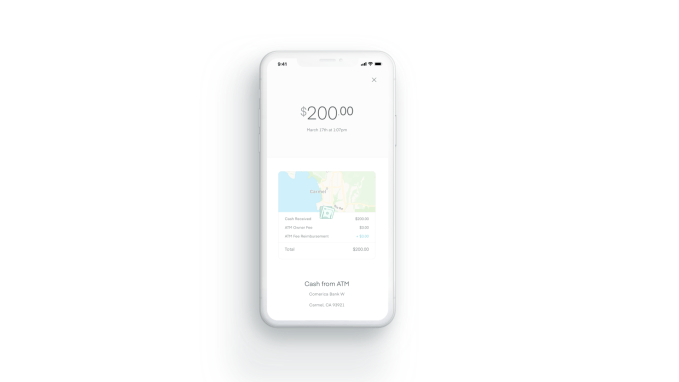
Overall, Zero’s design feels clean and simple, compared to the cluttered and dated apps from traditional banks. It has smart features, too, like a detailed transaction view that shows the vendor’s logo and location on a map to make it easier to recognize purchases.
“Zero creates an innovative debit-style experience, with an elegant design, and truly compelling rewards. It’s a fabulous banking experience,” said Hans Morris, Managing Partner of Nyca Partners and former President of Visa, Inc., in a statement. “Few people understand how complex it is to launch either a credit card or a checking account program, and I believe Zero is the first U.S. startup to launch both,” he said.

Zero launched in November 2018, but only to a small number of customers. Though officially open for business, it was functioning more like a public beta — though it didn’t call it that at the time. Meanwhile, its waitlist continued to grow.

Today, there are still 204,000 people waiting to be allowed in — something that Galen says is now going to happen.

“We haven’t launched to everyone on the waitlist yet, but we expect to within the next few weeks,” he says.

Another interesting twist on traditional credit cards is Zero’s path to card upgrades: it encourages but also rewards customers for telling their friends. By doing so, customers gain access to better-looking cards and higher cash back percentages.
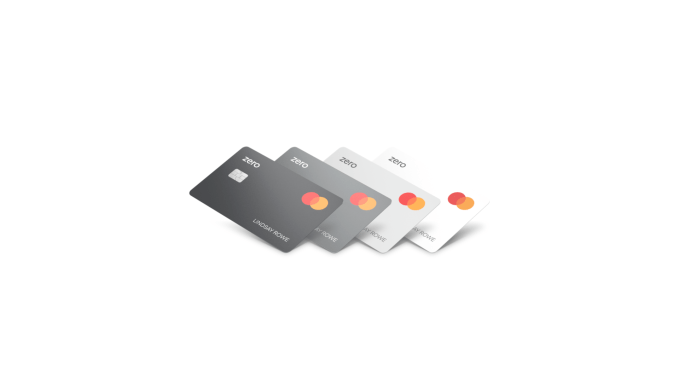
Zero customers start with a “Quartz” card offering 1 percent back on purchases. When a friend they refer joins, they receive a higher-level card called “Graphite” that offers 1.5 percent back. Two friends earns you the “Magnesium” card with 2 percent back and four friends gets you the “Carbon” card with 3 percent back. The Carbon card is also solid metal, capitalizing on the millennial trend of wanting their cards to look cool. And metal cards are in particular demand.

To receive the full cash back rates, customers have to pay their balances in full by the due date, Zero says.

The company has partnered with Salt Lake City-based WebBank to issue the card, and deposits are held at Memphis-based Evolve Bank & Trust, an FDIC member. Zero makes money primarily on interchange and interest on deposits.

While some users may leave balances on the card that generate interest, Zero isn’t focused on that aspect of the business for revenue generation.
“Most companies in fintech today are launching undifferentiated debit cards as a feature or extension to their product for an additional engagement and monetization stream,” says Rick Yang, partner at NEA, as to why he invested.

“Zero is completely focused on their card programs and building a differentiated solution that actually provides a value proposition that resonates with consumers. We’ve also been fascinated by the growth of debit outpacing credit, and we think that our solution gives consumers the best of both worlds,” he adds.

Zero is currently iOS-only, but is working on an Android version which is expected to be ready in August.


Facebook releases community standards enforcement report

Facebook has just released its latest community standards enforcement report and the verdict is in: people are awful, and happy to share how awful they are with the world.

The latest effort at transparency from Facebook on how it enforces its community standards contains several interesting nuggets. While the company’s algorithms and internal moderators have become exceedingly good at tracking myriad violations before they’re reported to the company, hate speech, online bullying, harassment and the nuances of interpersonal awfulness still have the company flummoxed.

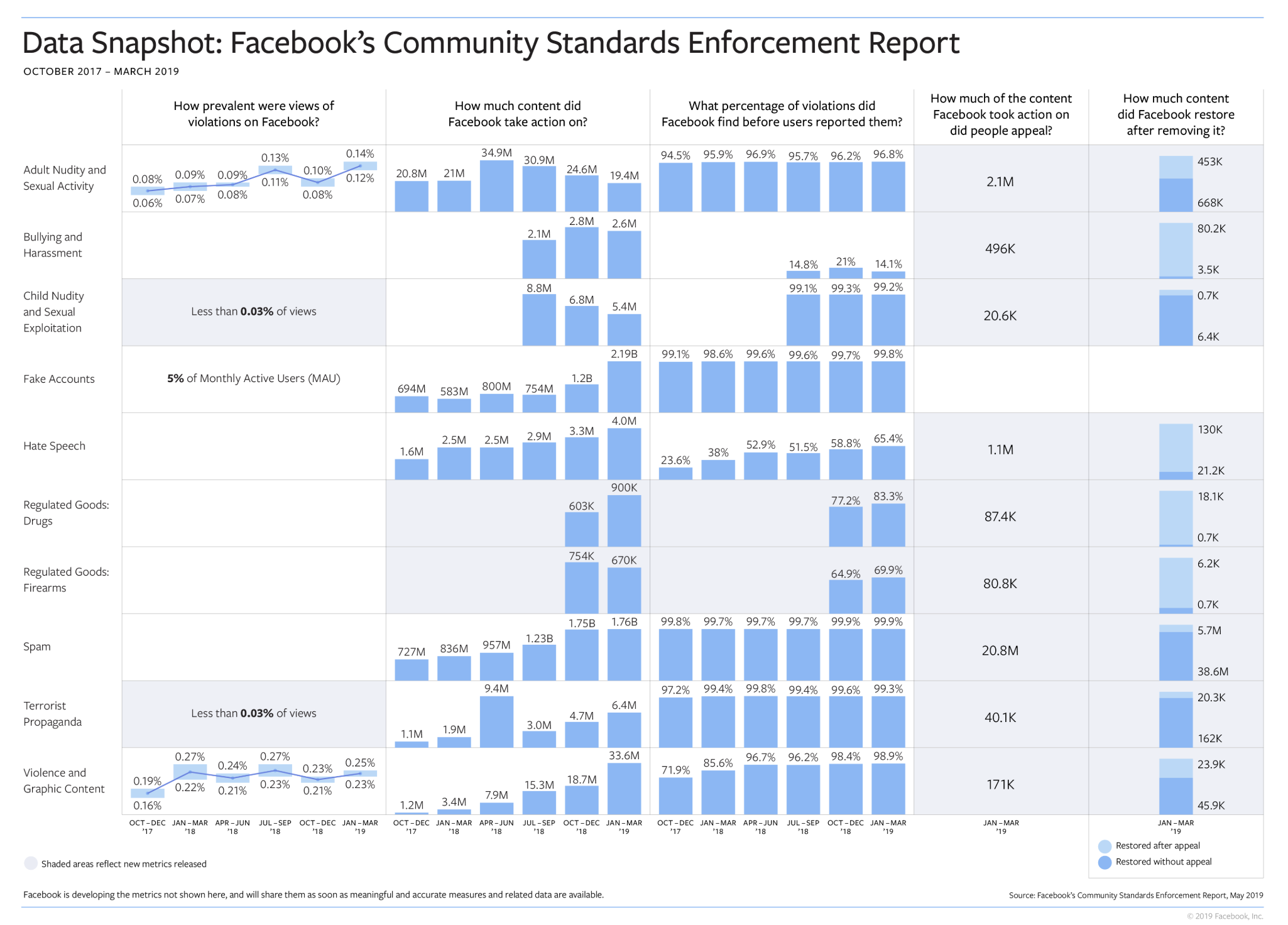
In most instances, Facebook is able to enforce its own standards and catches between 90% and over 99% of community standards violations itself. But those numbers are far lower for bullying, where Facebook only caught 14% of the 2.6 million instances of harassment reported; and hate speech, where the company internally flagged 65.4% of the 4.0 million moments of hate speech users reported.

By far the most common violation of community standards — and the one that’s potentially most worrying heading into the 2020 election — is the creation of fake accounts. In the first quarter of the year, Facebook found and removed 2.19 billion fake accounts. That’s a spike of 1 billion fake accounts created in the first quarter of the year.

Spammers also keep trying to leverage Facebook’s social network — and the company took down nearly 1.76 billion instances of spammy content in the first quarter.

For a real window into the true awfulness that people can achieve, there are the company’s self-reported statistics around removing child pornography and graphic violence. The company said it had to remove 5.4 million pieces of content depicting child nudity or sexual exploitation and that there were 33.6 million takedowns of violent or graphic content.

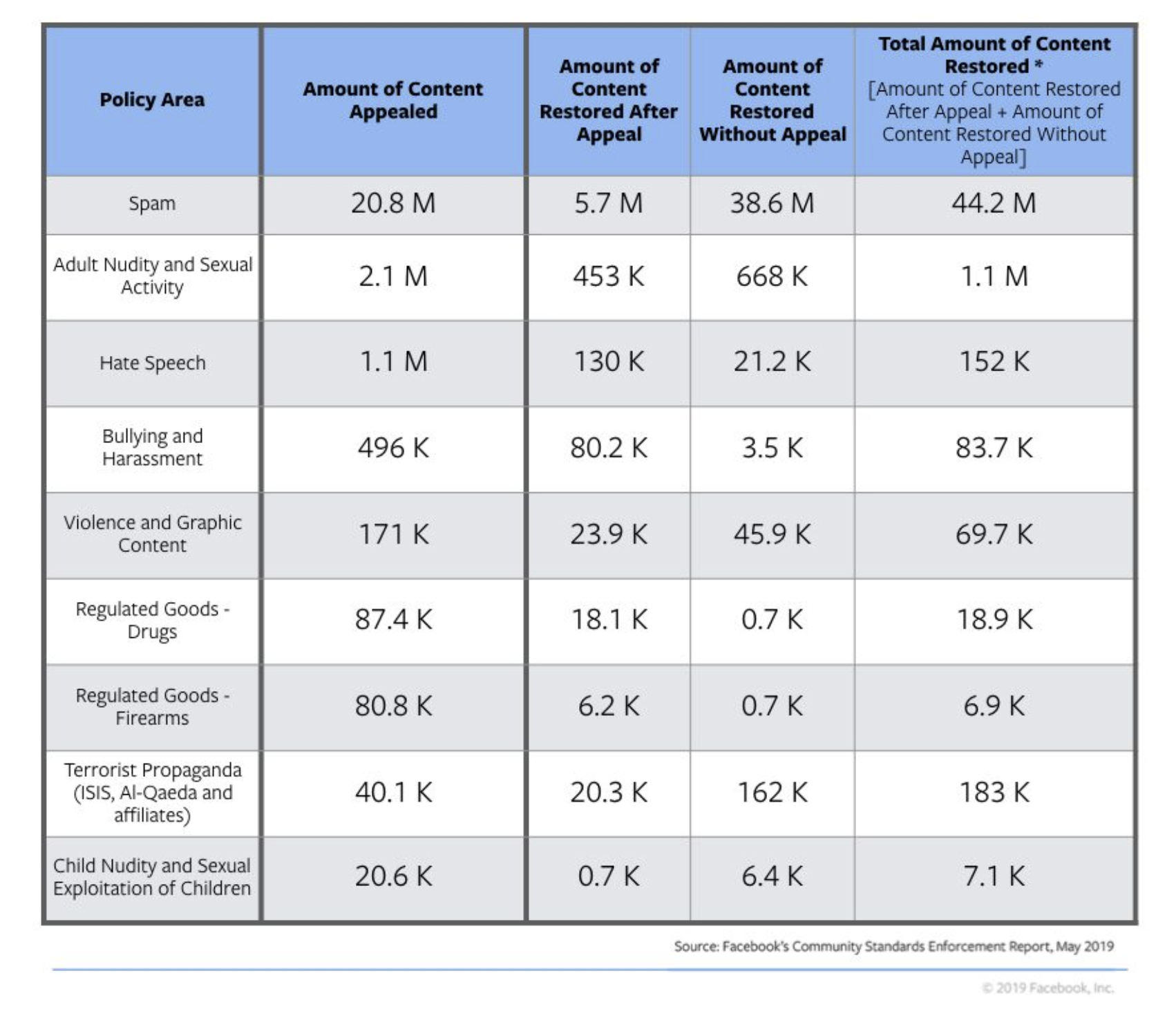
Interestingly, the areas where Facebook is the weakest on internal moderation are also the places where the company is least likely to reverse a decision on content removal. Although posts containing hate speech are among the most appealed types of content, they’re the least likely to be restored. Facebook reversed itself 152,000 times out of the 1.1 million appeals it heard related to hate speech. Other areas where the company seemed immune to argument was with posts related to the sale of regulated goods like guns and drugs.

In a further attempt to bolster its credibility and transparency, the company also released a summary of findings from an independent panel designed to give feedback on Facebook’s reporting and community guidelines themselves.

Facebook summarized the findings from the 44-page report by saying the commission validated Facebook’s approach to content moderation was appropriate and its audits well-designed “if executed as described”.

The group also recommended that Facebook develop more transparent processes and greater input for users into community guidelines policy development.

Recommendations also called for Facebook to incorporate more of the reporting metrics used by law enforcement when tracking crime.

“Law enforcement looks at how many people were the victims of crime — but they also look at how many criminal events law enforcement became aware of, how many crimes may have been committed without law enforcement knowing and how many people committed crimes,” according to a blog post from Facebook’s Radha Iyengar Plumb, Head of Product Policy Research. “The group recommends that we provide additional metrics like these, while still noting that our current measurements and methodology are sound.”

Finally the report recommended a number of steps for Facebook to improve, which the company summarized below.

  • Additional metrics we could provide that show our efforts to enforce our polices such as the accuracy of our enforcement and how often people disagree with our decisions
  • Further break-downs of the metrics we already provide, such as the prevalence of certain types of violations in particular areas of the world, or how much content we removed versus apply a warning screen to when we include it in our content actioned metric
  • Ways to make it easier for people who use Facebook to stay updated on changes we make to our policies and to have a greater voice in what content violates our policies and what doesn’t

Meanwhile examples of what regulation might look like to ensure that Facebook is taking the right steps in a way that is accountable to the countries in which it operates are beginning to proliferate.

It’s hard to moderate a social network that’s larger than the world’s most populous countries, but accountability and transparency are critical to preventing the problems that proliferate on those networks from putting down permanent, physical roots in the countries where Facebook operates.


Apply to TC Hackathon at Disrupt SF 2019 before the spots disappear

Calling all code whisperers, rock-star programmers and code poets. If you want to compete in the TechCrunch Hackathon at Disrupt San Francisco 2019 on October 2-4, do not wait. We’re limiting the hackathon to only 800 participants, and half of those spots are already gone, baby, gone. Don’t miss your chance for glory, cash and prizes. Apply for the hackathon today.

An important reminder: Applying to, and participating in, the hackathon is free. Plus, all competitors receive Expo Only passes for days one and two and an Innovator pass for day three of Disrupt SF.

This hackathon will challenge you both mentally and physically. Teams consisting of 4-6 people will choose one of several sponsored hack challenges and use sponsored APIs, data sets and other tools to design and build a creative solution to a real-world problem — in roughly 24 hours. Don’t have a team? No problem, we’ll help you find one when you arrive.

It’s an all-out push to the finish, and we’ll fuel your ambition with free food, beer and plenty of coffee and Red Bull.

When the clock runs out, judges from both the sponsors and TechCrunch will review each project, science-fair style. Ten finalists will be selected to present a 60-second demo the next day on the Extra Crunch stage at Disrupt SF.

Individual sponsors award a variety of prizes, including cash, to the team with the project that best addresses the specific challenge. But hold on now, there’s one more jewel in the hackathon crown. TechCrunch editors will select one team as the best overall hack and award a grand prize of $10,000.

We’ll have more information about this year’s sponsors — and the specific challenges and prizes they offer — in the coming weeks. But if you want an idea of what you might encounter, review the sponsored contests, prizes and winners from Disrupt SF 2018. Want more details? Learn more about what to expect at the hackathon.

The TechCrunch Hackathon goes down at Disrupt San Francisco 2019 on October 2-4, and your savvy competitors have already snapped up half of the available spots. If you want to pit your skills against the best coders and designers in the world, sign up for the hackathon now. We can’t wait to see the amazing projects you create in San Francisco!

Is your company interested in sponsoring the Hackathon at Disrupt San Francisco 2019? Contact our sponsorship sales team by filling out this form.

Google integrates food delivery services into Search, Maps and Assistant

Google today announced that it is launching the ability to order food delivery directly from Google Search, Maps and the Assistant. Google itself isn’t getting into the delivery game, though. Instead, it is partnering with companies like DoorDash, Postmates, Delivery.com, Slice and ChowNow. Support for Zuppler and others is ‘coming soon.’ The ordering experience, though, is deeply integrated into Google’s tools and you can pay with Google Pay.

For restaurants that participate, you’ll soon see and ‘Order Online’ button in Search and Maps when you search for a specific restaurant or cuisine.

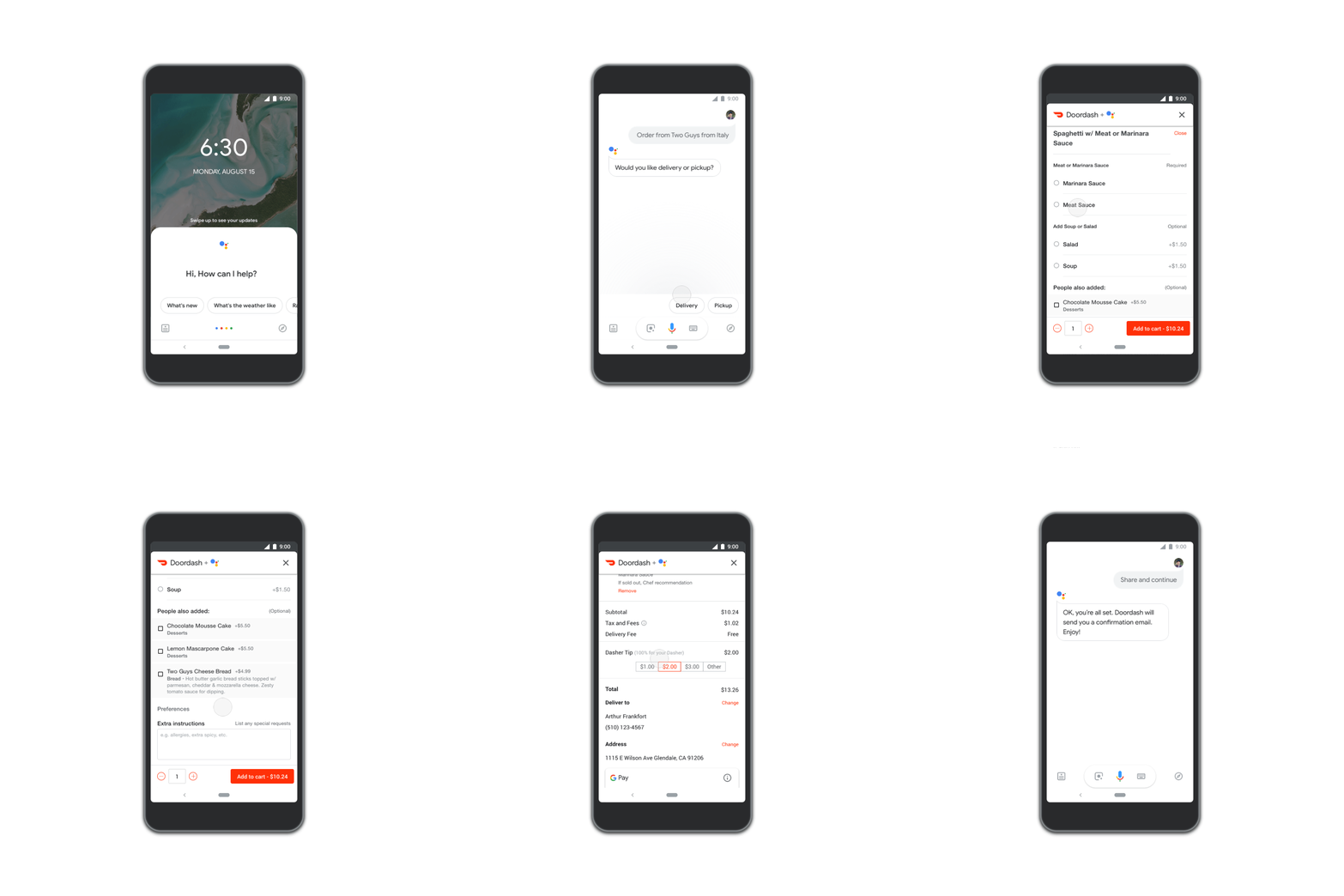
While Seach and Maps are probably the way most people will use this feature, Google is also building this feature into the Assistant. Here, you’ll be able to say: “Hey Google, order food from [name of your favorite take-out restaurant].” This is supported on Android and iOS. You can even re-order your regular go-to-meal using nothing but your voice. Since it would be somewhat impractical to have the Assistant read you the menu, the initial command really only kicks off a tap-driven experience that has you select menu items and confirm the order. To reorder, you won’t have to do that, though.