Daily Crunch: Trump targets Huawei with emergency declaration

The Daily Crunch is TechCrunch’s roundup of our biggest and most important stories. If you’d like to get this delivered to your inbox every day at around 9am Pacific, you can subscribe here.

1. Trump declares national emergency to protect US networks from foreign espionage

While the U.S. already restricted government contractors and federal agencies from using technology supplied by Huawei or its subsidiaries, this new executive order gives Commerce Secretary Wilbur Ross and other federal agencies broad powers of oversight and approval over private company transactions.

It seems that tech has been on Trump’s mind, as the White House also launched a website aimed at collecting reports of social media censorship due to their political views.

2. Instagram is killing Direct, its standalone Snapchat clone app, in the next several weeks

Facebook says that moving forward, the Instagram team will channel all developments and activity into the direct messaging feature of the main Instagram app.

3. Europol, DOJ announce the takedown of the GozNym banking malware

Europol and the U.S. Justice Department, with help from six other countries, have disrupted and dismantled the GozNym malware, which they say stole more than $100 million from bank accounts since it first emerged.

4. Mobile ticketing company TodayTix raises $73M in new funding

TodayTix says it’s now sold more than 4 million tickets, representing 8% of annual Broadway ticket sales and 4% for London’s West End.

5. Samsung reportedly readying Galaxy Fold for release after finding ‘fix’

According to reporting from Yonhap News Agency, Samsung is currently testing the handset with mobile carriers in Korea, putting the phone’s official release some time next month.

6. Walmart beats on earnings in Q1, with US e-commerce up by 37%

The company has been heavily investing in the key categories of home, fashion and grocery over the past several years as part of its efforts to better compete with Amazon.

7. Reality Check: The marvel of computer vision technology in today’s camera-based AR systems

AR experiences can seem magical, but what exactly is happening behind the curtain? (Extra Crunch membership required.)

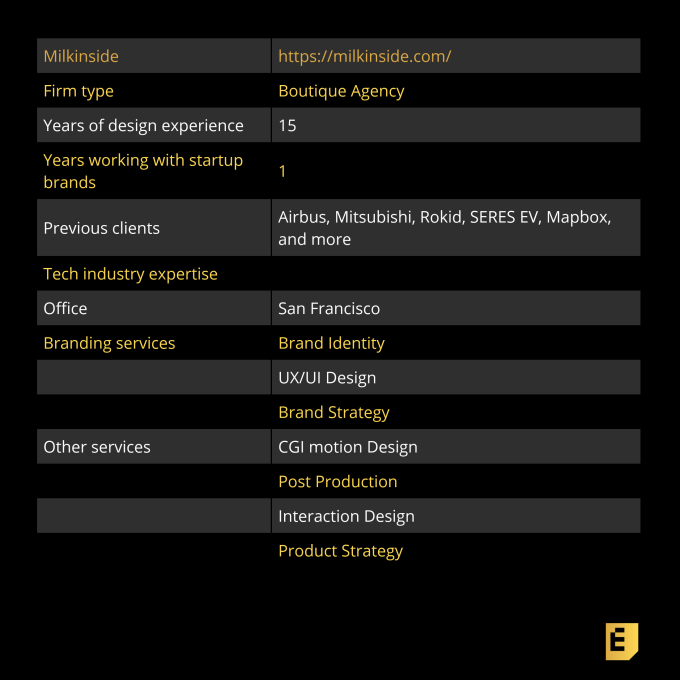
Verified Expert Brand Designer: Milkinside

Gleb Kuznetsov refuses to settle for less. After spending years leading product design for startups and corporate clients, Gleb started a boutique branding agency, Milkinside, that helps clients translate new technologies into useful products.

Gleb and his team of experienced creators are committed to serving the end user, which is why they love taking products from zero to launch. Their services are expensive, partly due to their expertise in product development, motion graphic design and animation, but we spoke to Gleb about why Milkinside is more than just a branding agency and how they strive to be the best.

Why Gleb created Milkinside:

“I wanted to create a team that wasn’t just an agency that companies could contract, but a partner that would support the client’s product development from beginning to end. Everything from the product narrative, product branding, product design, UI user experience, motion design, design languages, motion design languages, etc. I looked around the industry and didn’t see what I was envisioning so I created my dream company, Milkinside, in 2018.”

“Gleb has one of those rare skills that can make ordinary, plain parts of a design come to life and doing so in a beautiful and useful way. Always pushing the boundaries.” Jacob Hvid, Stockholm, Sweden, CEO and Co-founder at Abundo

On common founder mistakes:

“There are a lot of founders who believe they created useful technology and are absolutely certain people will use it. But everything is moot if users aren’t able to understand your product narrative and how it fits into their lives. Establishing a product narrative at an early stage is essential. A lot of founders will try to create a minimum viable product as soon as possible, but they aren’t thinking about the narrative, branding, the product design, and how everything comes together.”

Below, you’ll find the rest of the founder reviews, the full interview, and more details like pricing and fee structures. This profile is part of our ongoing series covering startup brand designers and agencies with whom founders love to work, based on this survey and our own research. The survey is open indefinitely, so please fill it out if you haven’t already.


Interview with Milkinside Founder and Director of Product Design Gleb Kuznetsov

Yvonne Leow: Can you tell me a little bit about yourself and how you got into the world of branding and design?

Gleb Kuznetsov: I was 10 years old when I started programming and learning different coding languages. At the age of 15, I shifted to design and became pretty passionate about what could be possible in the digital world. I worked as a product designer for 15 years before I started Milkinside. I worked for big consumer product companies across various verticals and platforms. When I was a chief design officer at a startup, I was responsible for everything from the product design, UI design, branding, advertising to producing product explainer videos.

Samsung’s 5G phone hits Verizon, Sprint getting two 5G devices this month

With 5G, when it rains, it pours. A few hours after Verizon officially started selling the Samsung Galaxy S10 5G, Sprint announced that it will be offering two 5G devices for its network by the end of the month.

For now, it still feels like manufacturers are putting the cart before the horse here. There’s little question that 5G will become ubiquitous in the next few years, but actual opportunities to access the technology are still pretty scarce.

Among U.S. carriers, Verizon (or parent company’s parent company) has been the most aggressive. Fitting then, that the company is first to market with the Galaxy S10 5G. Of course all of these devices while default to 4G when there’s no 5G to be found, which is going to be the case more often than not for a while.

Verizon’s 5G is currently available in select markets, including Chicago and Minneapolis. That number is set to balloon to 20 before year’s end, including, Atlanta, Boston, Charlotte, Cincinnati, Cleveland, Columbus, Dallas, Des Moines, Denver, Detroit, Houston, Indianapolis, Kansas City, Little Rock, Memphis, Phoenix, Providence, San Diego, Salt Lake City and Washington, DC.

Sprint, meanwhile, has promised to flip on 5G in nine markets “in the coming weeks.” The list includes parts of Atlanta, Dallas, Houston and Kansas City, and then locations in Los Angeles, New York City, Phoenix and Washington D.C.

To celebrate, the network will be offering two 5G devices this month. The LG V50 ThinQ and HTC 5G Hub will hit Sprint stores on May 31.

MultiVu raises $7M seed round for its next-gen 3D sensor

MultiVu, a Tel Aviv-based startup that is developing a new 3D imaging solution that only relies on a single sensor and some deep learning smarts, today announced that it has raised a $7 million seed round. The round was led by crowdfunding platform OurCrowd, Cardumen Captial and Hong Kong’s Junson Capital.

Tel Aviv University’s TAU Technology Innovation Momentum Fund supported some of the earlier development of MultiVu’s core technology, which came out of Prof. David Mendlovic’s lab at the university. Mendlovic previously co-founded smartphone camera startup Corephotonics, which was recently acquired by Samsung.

The promise of MultiVu’s sensor is that it can offer 3D imaging with a single-lens camera instead of the usual two-sensor setup. This single sensor can extract depth and color data in a single shot.

This makes for a more compact setup and, by extension, a more affordable solution since it requires fewer components. All of this is powered by the company’s patented light field technology.

Currently, the team is focusing on using the sensor for face authentication in phones and other small devices. That’s obviously a growing market, but there are also plenty of other application for small 3D sensors, ranging from other security use cases to sensors for self-driving cars.

“The technology, which passed the proof-of-concept stage will bring 3D Face Authentication and affordable 3D imaging to the mobile, automotive, industrial and medical markets,” MultiVu CEO Doron Nevo said. “We are excited to be given the opportunity to commercialize this technology.”

Right now, though, the team is mostly focusing on bringing its sensor to market, though. The company will use the new funding for that, as well as new marketing and business development activities.

“We are pleased to invest in the future of 3D sensor technologies and believe that MultiVu will penetrate markets, which until now could not take advantage of costly 3D imaging solutions,” said OurCrowd Senior Investment Partner Eli Nir. “We are proud to be investing in a third company founded by Prof. David Mendlovic (who just recently sold CorePhotonics to Samsung), managed by CEO Doron Nevo – a serial entrepreneur with proven successes and a superb team they have gathered around them.”

Unveiling its latest cohort, Alchemist announces $4 million in funding for its enterprise accelerator

The enterprise software and services focused accelerator, Alchemist has raised $4 million in fresh financing from investors BASF and the Qatar Development Bank, just in time for its latest demo day unveiling 20 new companies.

Qatar and BASF join previous investors including the venture firms Mayfield, Khosla Ventures, Foundation Capital, DFJ, and USVP, and corporate investors like Cisco, Siemens and Juniper Networks.

While the roster of successes from Alchemist’s fund isn’t as lengthy as Y Combinator, the accelerator program has launched the likes of the quantum computing upstart, Rigetti, the soft-launch developer tool LaunchDarkly, and drone startup Matternet .

Some (personal) highlights of the latest cohort include:

  • Bayware: Helmed by a former head of software defined networking from Cisco, the company is pitching a tool that makes creating networks in multi-cloud environments as easy as copying and pasting.
  • MotorCortex.AI: Co-founded by a Stanford Engineering professor and a Carnegie Mellon roboticist, the company is using computer vision, machine learning, and robotics to create a fruit packer for packaging lines. Starting with avocados, the company is aiming to tackle the entire packaging side of pick and pack in logistics.
  • Resilio: With claims of a 96% effectiveness rate and $35,000 in annual recurring revenue with another $1 million in the pipeline, Resilio is already seeing companies embrace its mobile app that uses a phone’s camera to track stress levels and application-based prompts on how to lower it, according to Alchemist.
  • Operant Networks: It’s a long held belief (of mine) that if computing networks are already irrevocably compromised the best thing that companies and individuals can do is just encrypt the hell out of their data. Apparently Operant agrees with me.  The company is claiming 50% time savings with this approach, and have booked $1.9m in 2019 as proof, according to Alchemist.
  • HPC Hub: HPC Hub wants to  democratize access to supercomputers by overlaying a virtualization layer and pre-installed software on underutilized super computers to give more companies and researchers easier access to machines… and they’ve booked $92,000 worth of annual recurring revenue.
  • DinoPlusAI: This chip developer is designing a low latency chip for artificial intelligence applications, reducing latency by 12 times over a competing Nvidia chip, according to the company. DinoPlusAI sees applications for its tech in things like real-time AI markets and autonomous driving. Its team is led by a designer from Cadence and Broadcom and the company already has $8 million in letters of intent signed, according to Alchemist.
  • Aero Systems West Co-founders from the Air Force’s Research Labs and MIT are aiming to take humans out of drone operations and maintenance. The company contends that for every hour of flight time, drones require 7 hours of maintenance and check ups. Aero Systems aims to reduce that by using remote analytics, self-inspection, autonomous deployment, and automated maintenance to take humans out of the drone business.

Watch a livestream of Alchemist’s demo day pitches, starting at 3PM, here.


Vertex Ventures hits $230M first close on new fund for Southeast Asia and India

Tis the season to be raising in India and Southeast Asia. Hot on the heels of new funds from Strive and Jungle Ventures, so Singapore’s Vertex Ventures, a VC backed by sovereign wealth fund Temasek, today announced a first close of $230 million for its newest fund, the firm’s fourth to date.

Vertex raised $210 million for its previous fund two years ago, and this new vehicle is expected to make a final close over the coming few months with more capital expected to roll in. If you care about numbers, this fund may be the largest dedicated to Southeast Asia although pedants would point out that the Vertex allocation also includes a focus on India, echoing the trend of funds bridging the two regions. There are also Singapore-based global funds that have raised more, for example, B Capital from Facebook co-founder Eduardo Saverin.

Back to Vertex, it’s worth recalling that the firm’s third fund was its first to raise from outside investors — having previously taken capital from parent Temasek. Managing partner Chua Kee Lock told Bloomberg that most of those LPs signed on for fund four including Taiwan-based Cathay Life Insurance. Vertex said in a press release that it welcomed some new backers, but it did not provide names.

The firm has offices in Singapore, Jakarta and Bangalore and its most prominent investments include ride-hailing giant Grab, fintech startup InstaRem, IP platform PatSnap and Vision Fund-backed kids e-commerce firm FirstCry. Some of its more recent portfolio additions are Warung Pintar — which is digitizing Indonesia’s street kiosk vendors — Binance — which Vertex backed for its Singapore entity — and Thailand-based digital insurance play Sunday.

One differentiator that Vertex offers in Southeast Asia and India, beyond its ties to Temasek, is that there are connections with five other Vertex funds worldwide. Those include a new global growth fund, and others dedicated to global healthcare as well as startups in Israel and the U.S.

Others VCs operating in Southeast Asia’s Series A/B+ bracket include Jungle Ventures, which just hit first close on a new fund aimed at $220 million, Openspace Ventures, which closed a $135 million fund earlier this year, Sequoia India and Southeast Asia, which raised $695 million last year, Golden Gate Ventures, which has a third fund of $100 million, and Insignia Ventures, which raised $120 million for its maiden fund.

Growth funds are also increasingly sprouting up. Early stage investor East Ventures teamed up with Yahoo Japan and SMDV to launch a $150 million vehicle, while Golden Gate Ventures partnered with anchor LP Hanwha to raise a $200 million growth fund.

Replex gets $2.45M seed round to help track cloud native spend

Replex wants to help track cloud spending, but with a cloud native twist, and today it announced a $2.45 million seed round. The company previous raised $1.68 million in 2017 for a total of $4.15 million so far.

As companies shift to a cloud native environment, and move ever more quickly, it is increasingly important to get visibility into how development and operations teams are using resources in the cloud. Replex is designed to give more visibility into spending and to help optimize the container environment in the most economical way.

Company CEO and co-founder Patrick Kirchhoff says the product is about controlling spending in a cloud native context. “The Replex platform enables operators, finance and IT managers to see who spends what. We allow them then to right-size clusters, pods and container sizes for optimal results, and they are able to control the cost, manage chargebacks and find [optimal] capacity,” he explained.

Replex cloud spending control panel

Replex cloud spending control panel. Screenshot: Replex

While there are variety of similar cloud cost control startups out there, Kirchoff says his company has been purpose built for cloud native environments and that is a key differentiating factor. “We see that the way organizations work has completely changed because with the move to cloud native infrastructure, teams within the business lines are now able to provision infrastructure on their own. Central IT departments still need to control costs and govern these resources, but they don’t have the tools to do that anymore because the existing tools are built on architectures for traditional infrastructure, and not for the cloud native approach,” he said.

Kirchoff says that developers tend to over provision just to be on the safe side, but using data from Replex, customers can figure out the optimal amount to provision for a particular workload, work with development teams, and that can save money in the long run.

Investors across the two rounds include Entrepreneurs Investment Fund, eValue, EnBW New Ventures, High-Tech Gruenderfonds (HTGF) and Technologiegruenderfonds Sachsen (TGFS). The company is currently participating in the Alchemist Accelerator . The latest round closed in December. The previous one in May 2017.

Facebook changes algorithm to promote worthwhile & close friend content

Facebook is updating the News Feed ranking algorithm to incorporate data from surveys about who you say are your closest friends and which links you find most worthwhile. Today Facebook announced it’s trained new classifiers based on patterns linking these surveys with usage data so it can better predict what to show in the News Feed. The change could hurt Pages that share click-bait and preference those sharing content that makes people feel satisfied afterwards.

For close friends, Facebook surveyed users about which people they were closest too. It then detected how this matches up with who you are tagged in photos with, constantly interact with, like the same post and check in to the same places as, and more. That way if it recognizes those signals about other people’s friendships, it can be confident those are someone’s closest friends they’ll want to see the most of. You won’t see more friend content in total, but more from your best pals instead of distant acquaintances.

For worthwhile content, Facebook conducted surveys via news feed to find out which links people said were good uses of their time. Facebook then detected which types of link posts, which publishers, and how much engagement the posts got and matched that to survey results. This then lets it determine that if a post has a simialr style and engagement level, it’s likely to be worthwhile and should be ranked higher in the feed.

The change aligns with CEO Mark Zuckerberg’s recent comments declaring that Facebook’s goal isn’t total time spent, but time well spent with meaningful content you feel good about.

Walmart beats on earnings in Q1, with U.S. e-commerce up by 37 percent

Walmart’s investments in e-commerce are paying off. The retailer today announced its U.S. e-commerce sales grew by 37 percent in the first quarter, largely thanks to its booming online grocery business and growth in both the home and fashion categories on Walmart.com.

The company also beat analyst estimates for the quarter, with earnings per share of $1.13 versus $1.02 expected, and revenue of $123.93 billion compared to estimates of $125.03 billion. U.S. same-store sales growth was 3.4 percent in the quarter, versus the expected 3.3 percent increase — making it the fourth consecutive quarter above 3 percent, and the best Q1 in 9 years.

Operating income, however, declined in the quarter, as strong sales from Walmart U.S. and Sam’s Club stores were offset by the inclusion of Flipkart, the retailer said.

The company has been heavily investing in the key categories of home, fashion and grocery over the past several years as part of its efforts to better compete with Amazon and expand into categories where there’s still much room for online growth.

In Home, for example, Walmart last year launched a redesigned Home shopping experience on the web that highlighted furniture, home accessories and other decorative items, broken down by style categories. The updated site also had a more editorial feel with larger, magazine-like imagery and design tips written by in-house staff.

Later in the year, the full Walmart.com redesign rolled out, which put an increased emphasis on specialty shopping experiences across home and fashion — the latter featuring seasonal stories and fashion editorial to make buying an outfit feel much different from buying groceries or other household items. The fashion destination went upscale, as well, with a section dedicated to Lord & Taylor — the result of a partnership that made Walmart the new e-commerce home for the high-end retailer.

Meanwhile, Walmart has been expanding its online grocery business with an eye towards leveraging its thousands of brick-and-mortar storefronts across the U.S.

Instead of marking up prices like Instarcart does, Walmart lets customers order groceries online and pay the same price as they would in stores. Customers then drive the mile or two to their local Walmart and pick up their prepared and bagged groceries at a dedicated curbside pickup spot.

The pickup service is available at 2,450 Walmart locations while grocery delivery is offered through partners like Point Pickup, Skipcart, AxleHire, Roadie, Postmates and Doordash at nearly 1,000 locations. The retailer plans to offer pickup at 3,100 locations and delivery at 1,600 by year-end, providing coverage to approximately 50 percent and nearly 80 percent of the U.S. population, respectively.

Other e-commerce investments in Q1 included the launched a new personalized baby registry and online pet pharmacy, the introduction of Walmart Voice Order through Google Assistant, and the addition of several exclusive brands online — including denim from Sofia Vergara, the MoDRN brand in the Home category, the Hello Bello brand in the Baby category with Kristen Bell and Dax Shepard, the Flower brand in the Home category with Drew Barrymore, and Bobbi Brown’s health and wellness line Evolution_18.

Walmart also partnered with Kidbox for personalized kids’ fashion through Walmart.com, and made investments to reach lower-income shoppers. On the latter front, it partnered with Affirm for alternative financing and began piloting the acceptance of SNAP for online groceries through a new USDA-backed program.

And just this week, Walmart announced a new NextDay delivery service which will offer one-day delivery of over 200,000 of the most popular items for one-day delivery.

“We’re changing to enable more innovation, speed and productivity, and we’re seeing it in our results,” Walmart CEO Doug McMillon said in a statement. “We’re especially pleased with the combination of comparable sales growth from stores and e-commerce in the U.S. Our team is demonstrating an ability to serve customers today while building new capabilities for the future, and I want to thank them for a strong start to the year.”


How to see our world in a new light

Startups are ultimately vessels of speculation, of new products, new markets, and innovations the world has never seen. While data and information are important components for exploring the frontiers of the possible, perhaps the best way is through stories and fiction, and especially speculative fiction.

We’ve been fortunate at Extra Crunch to have noted novelist Eliot Peper write a guide to the novels that are and should be helping founders build startups in Silicon Valley these days. This week, Eliot published the final book in his Analog trilogy, which explores contemporary issues through a futuristic technology lens. With Breach, he brings to a close his tale of algorithmic geopolitics that started with Bandwidth (which I reviewed on TechCrunch) and continued with Borderless, all the while exploring topics of privacy, social media psychops, and the future of democracy.

I wanted to catch up with Eliot and chat not only about his latest work, but also the themes inherent in the novels as well as his process for generating new ideas and seeing the world from a new perspective, a skill critical for any creative or founder.

The following interview has been edited and condensed for clarity.